
.png)
Mine operators live by availability targets, not purchase order savings. In Africa’s project corridors, the distance between a signed quote and a commissioned unit on site is where mining schedules break. The solution isn’t sharper contract negotiation—it’s forcing procurement to engineer route strength, delivery control, and landed cost from specification through handover.
What Makes Mining Procurement in Africa Operationally Critical
The tension is structural: pit plans demand uptime certainty while procurement teams chase unit-price victories. Across African corridors, these incentives create invisible project risk.
Availability never equals deliverability. A machine “ready ex-works” can miss your dry-season window, exceed bridge axle limits on the only viable route, or sit unpaid at port because bond documentation fails customs reality. Unit price becomes meaningless when currency exposure, duties, transit insurance, oversize permits, escorts, transshipment delays, and contractor standby time convert the cheapest quote into the project’s most expensive mistake.
Supplier access doesn’t guarantee supplier control. Without serial verification, enforceable delivery milestones, and pre-shipment inspection protocols, substitutions and incomplete builds slip through. Traditional procurement governance helps with contract discipline and supplier management, but African mining adds a planning layer: route selection becomes an operational decision that must precede any commercial commitment.
The Operational Cost of Loose Procurement Routes
A loose route prioritizes fast purchase orders over corridor feasibility. Mine operators recognize the symptoms immediately:
Schedule damage cascades through the operation. Missed vessel slots, seasonal road closures, and permit rejections create month-long gaps. Emergency rentals and standby crews eliminate any procurement savings while production targets slip.
Landed-cost creep destroys project budgets. Unscoped escorts, re-routing to heavier pavements, additional axle configurations, emergency storage fees, and currency slippage generate 15–40% overruns that procurement never modeled.
Quality risk emerges at commissioning. Undocumented substitutions—different attachments, tire specifications, filtration systems—reduce availability on arrival. Missing toolkits and incomplete documentation slow the transition from delivery to productive operation.
Governance exposure creates disputes instead of delivery. Advance payments without delivery milestones, weak INCOTERMS alignment, and unclear risk transfer points generate legal friction when operators need equipment performance.
If these risks match your current procurement exposure, request a corridor and landed-cost assessment before your next equipment commitment.
What Commercially Controlled Sourcing Changes for Mine Operations
Commercially controlled sourcing treats procurement as an extension of mine planning. Three operator-controlled levers eliminate the gap between purchase and performance:
Lock Operational Windows Into Specifications and Corridor Planning
Define commissioning windows by weather patterns, road conditions, and pit readiness—make timing a gating requirement, not an aspiration. Dimension equipment for corridor reality: select boom configurations, counterweights, and transport options that clear height, width, and axle thresholds on your chosen route.
Confirm port and road logistics early. Choose between RORO, breakbulk, or containerized delivery based on documented transit times and verified capacity. Align customs documentation with regulatory reality: valuation methods, HS codes, exemptions, and any local-content requirements.
Demand route feasibility confirmation before purchase authorization. If the corridor fails on paper, the equipment isn’t truly “available.” Compare how different procurement routes affect total project exposure before committing to any supplier path.
Convert Supplier Access Into Delivery Control
Qualify suppliers for credibility, not just inventory claims. Require serial validation through OEM systems, complete build sheets, and visual proof-of-life tied to specific VIN and engine serial numbers.
Structure payments around verified delivery milestones: specification lock, pre-delivery inspection sign-off, export clearance, vessel loading confirmation, and on-site handover. Each payment stage must correspond to measurable progress toward your operational deadline.
Mandate comprehensive pre-delivery inspections covering mechanical, hydraulic, electrical, and telematics systems. Cross-check consumables and attachment inventories against original specifications. Effective Source-to-Pay integration ensures contract administration keeps pace with logistics complexity.
Write delivery control into contracts: vessel booking windows, transshipment rights, alternate corridor triggers, and financial penalties for route-breaking substitutions.
Own Total Landed Cost, Not Just Unit Price
Build comprehensive landed-cost models covering unit price, inland drayage, port charges, ocean freight, overland transport, escorts and permits, customs duties and VAT, insurance, foreign exchange, last-mile delivery, site assembly, and commissioning support.
Add risk allowances for seasonal delays, port congestion, and regulatory changes. Decide which variables you’ll pre-pay to remove uncertainty from project timelines.
Lock foreign exchange windows and freight capacity when routes are chosen, not after documentation begins. Bundle critical spares and wear parts into the same delivery route to protect early operational availability.
Use corridor scoring to compare alternatives on route strength, delivery control, and total landed cost. Evaluate country-specific corridor risks and landed-cost factors before selecting your procurement path.
When Procurement Risk Becomes Site-Critical
Procurement issues surface at the working face, not in purchase order systems. Operational triggers that demand immediate operator involvement:
- Fleet ramp-ups tied to weather windows or contractor mobilization schedules
- Border regime changes affecting duty treatment or axle enforcement on preferred corridors
- Pit access or laydown constraints that change how equipment must arrive—assembled versus modularized
- Mid-life rebuild versus import decisions when production schedules are already compressed
- Supplier substitution proposals that alter dimensions, weight, or powertrain support requirements
Operator actions that prevent schedule slippage:
Define commissioning windows and minimum uptime targets before issuing RFQs. Require written route feasibility studies with dimensioned load plans and permits calendars. Approve payment milestone structures that tie cash flow to verified delivery progress.
Validate supplier credibility and pre-delivery inspection evidence before export authorization. Lock landed-cost models and foreign exchange strategies with variance thresholds the project can absorb.
Commercial reality: in African mining, corridor planning must happen before procurement commitment. When mine operators control the three levers—operational window alignment, supplier delivery control, and comprehensive landed-cost governance—procurement transforms from a price contest into a delivery function.
Discuss the sourcing route for your next equipment requirement or request a corridor and landed-cost assessment to map the real risks before you commit.
Read next
Related posts

Africa's Critical Minerals Boom: Is Your Equipment Strategy Risking It All?
Africa's critical minerals boom is forcing rushed equipment decisions. Learn why a corridor-first procurement strategy is essential to protect project timelines, control landed costs, and avoid catastrophic delays.

Heavy Equipment Procurement in Africa: How to Avoid the Hidden Costs That Kill Project Timelines
Learn how to avoid devastating project delays in Africa. Focusing on unit price for heavy equipment is a trap; success lies in managing total delivered cost, from supplier credibility to route strength.
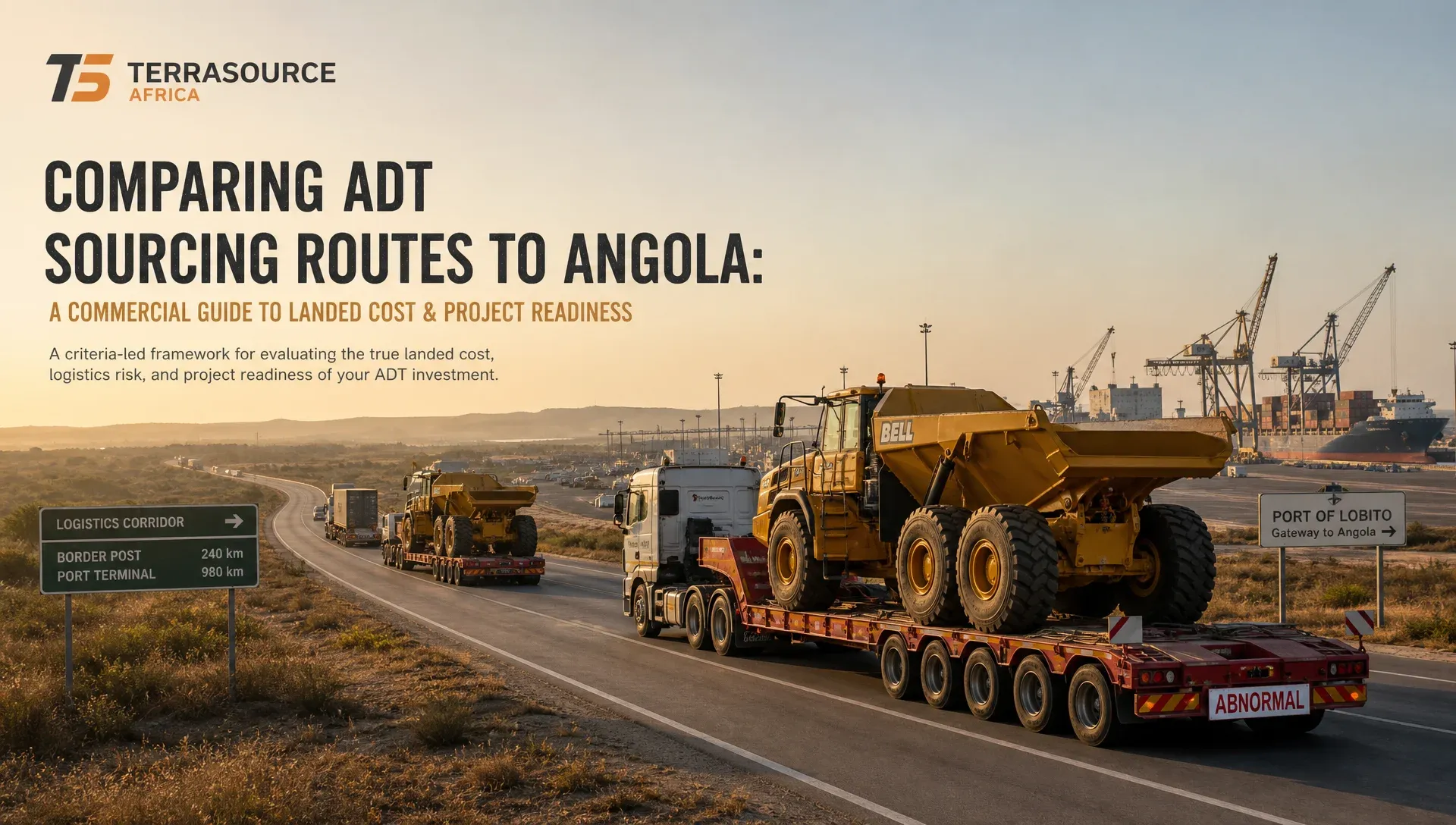
Articulated Dump Truck Angola: Which Sourcing Route Minimizes Project Risk?
Don't let hidden costs derail your Angola project. This guide compares three ADT sourcing routes—OEM, local agent, and integrated partner—to help you calculate true landed cost and manage delivery risk.