
.png)
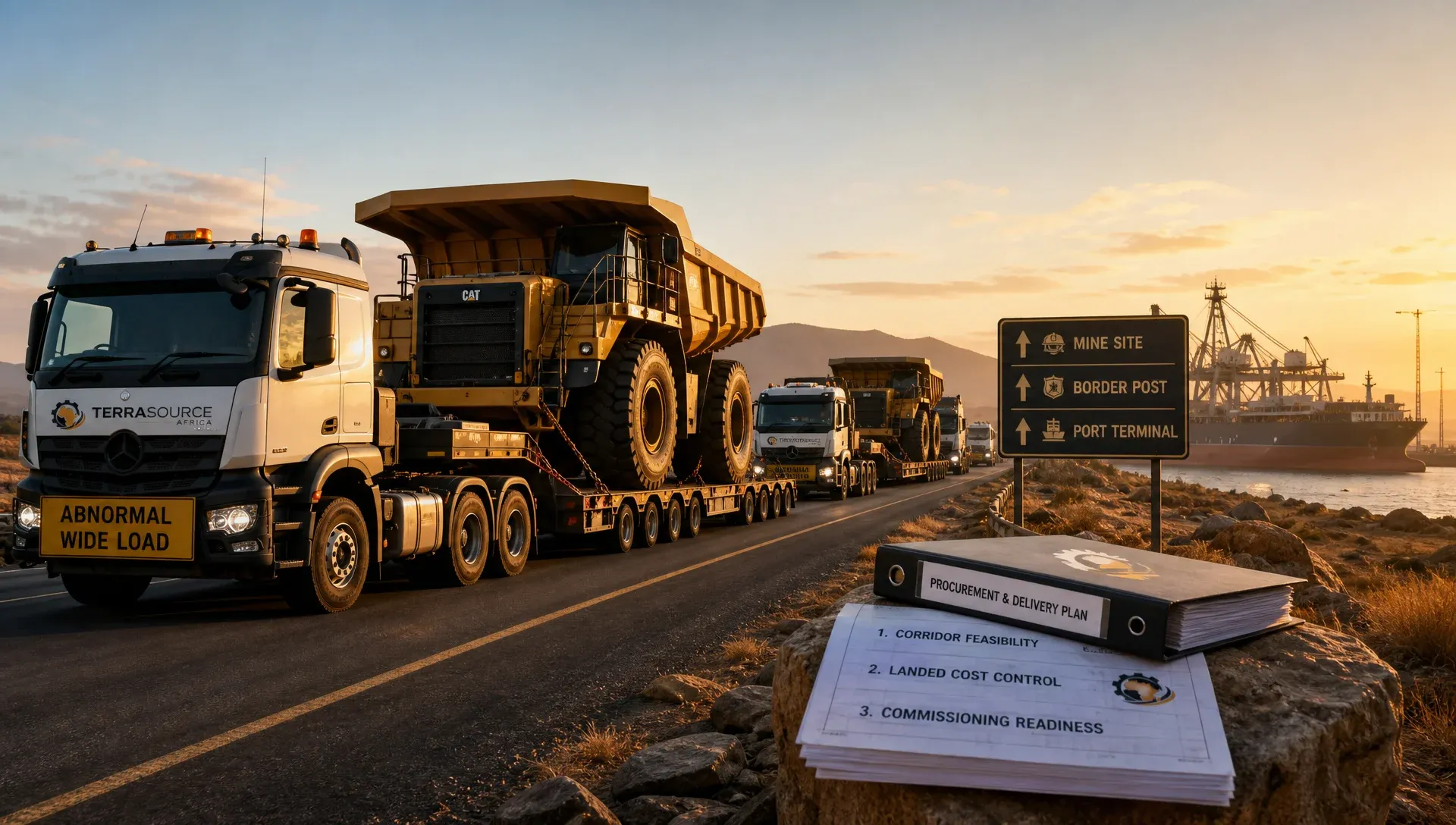
Africa’s critical minerals surge is compressing equipment procurement windows to breaking point. Under investor and EPC pressure, project teams chase the fastest excavator, ADT, or dozer quote available. That unit price feels decisive—until corridor realities surface. In African project delivery, availability never equals deliverability.
Why Equipment Decisions Keep Breaking Down in the Critical Minerals Rush
The global scramble for lithium, copper, cobalt, and graphite is reshaping procurement timelines across the continent, forcing teams into supplier-first choices that ignore route strength and delivery control. Africa’s critical minerals boom is accelerating development finance pressures, but three commercial pressures keep distorting buyer judgment:
Schedule compression drives commodity thinking
EPC milestones, financier drawdowns, and first-ore targets all advance. Mobile fleets get treated as standard purchases when they are project-critical mobile equipment requiring corridor-specific delivery planning.
Incomplete cost framing hides landed reality
Quotes stop at EXW or CFR terms. Corridor factors—abnormal permits, escort requirements, seasonal restrictions, specialized offload gear—emerge only after supplier commitment, when commercial leverage is lost.
Supplier access mistaken for supplier control
Being able to source a machine does not mean controlling its cross-border delivery. Supplier credibility must be proven against specific corridors, not demonstrated through brochures or stock availability.
When procurement leads with price and availability, corridor-specific risks remain unpriced. The result: late exposure to cost overruns, schedule penalties, and credibility damage with lenders.
The Cost of a Loose Route: Where Projects Bleed Time and Money
Weak corridor discipline inflates landed cost and destroys timeline integrity. Across Nacala, Lobito, Beira, Dar es Salaam, and Durban-linked routes, failure points follow predictable patterns:
Route and geometry traps
- Axle-load violations after last-minute spec changes (90-120t excavators shipped boom-on exceed bridge ratings)
- Underspecified lowbeds trigger police escort refusals or daylight-only restrictions, adding days per corridor leg
- Wet-season closures and gravel section detours never factored into original transit pricing
Regulatory and border friction
- Abnormal load windows require pre-booked escorts; weighbridge queues create 24-72 hour delays
- Customs valuation surprises, transit bond gaps, and mid-move ECTS requirements across multi-country legs
- Local content compliance and import permit timing missed; units stranded at port, accumulating demurrage
Ocean and port volatility
- OOG cargo rollovers, misaligned RoRo schedules, and crane capacity limits at secondary ports force costly shuttles
- Lash/unlash procedures without agreed method statements risk machine integrity and warranty coverage
Commercial leakage points
- EXW/CFR terms that transfer corridor risk without delivery control to the buyer
- Insurance gaps during machine disassembly; undocumented modifications void component warranties
The economics are brutal: one week of project delay typically exceeds any perceived “saving” from a cheaper unit or softer commercial terms. Availability is not deliverability—the corridor determines your real cost and schedule exposure.
If these corridor risks match your project reality, request a route and landed-cost assessment before committing to any supplier or commercial structure.
How a Stronger Sourcing Position Looks: Corridor-First Procurement Discipline
Commercially controlled sourcing starts with route strength, not supplier catalogs. A disciplined approach converts supplier availability into delivery control and predictable landed cost:
Corridor mapping precedes commitment
Fix mine gate coordinates, viable ports, and border choices. Price each leg under dry and wet season assumptions. Validate police escort availability and abnormal load windows before any supplier discussions.
Supplier credibility proven against route constraints
Shortlist only suppliers accepting route-driven packing lists, disassembly requirements, and documented method statements. Require evidence of successful cross-border deliveries on comparable corridors and weight classes.
Specifications tuned to corridor geometry
Match machine class to route constraints and axle laws. Examples: boom-off and counterweight separation for 80-120t excavators; tire removal and bowl separation on ADTs to meet specific bridge height and weight limits.
Commercial structure that buys delivery control
Move beyond price-only EXW/CFR terms. Structure contracts tying payment milestones to corridor milestones and mine-gate acceptance. Document handover points and risk transfer clearly.
Pre-shipment readiness and staging discipline
Workshop inspections completed, fluids and filters standardized, spares kitted for corridor duration, lifting plans issued, offload equipment reserved at destination.
Shipping window discipline with fallback capacity
Lock primary sailings with confirmed OOG handling; maintain backup routes and trucking capacity. Cost roll-risk and alternative port handling into base scenarios.
Route governance and delivery proof
Live movement tracking, escort bookings, border documentation pre-cleared. Gate photos, commissioning checklists, and damage protocols tied directly to warranty protection.
For detailed analysis of procurement route options and hidden cost exposure in each commercial structure, see Procuring Mobile Mining Equipment in Africa: 4 Routes and Their Hidden Costs.
When the Issue Becomes Operational: Corridor Reality Across Key Routes
Corridor risk converts to operational reality the moment equipment leaves the supplier yard:
Nacala corridor (northern Mozambique, Malawi projects)
Dry-season windows compress transit assumptions; wet season extends leg times by 20-40%. Bridge ratings require boom and stick separation on larger excavators. Police escorts operate on quota systems—incomplete paperwork means missed slots and extended delays.
Lobito corridor (DRC Copperbelt to Atlantic)
Rail-road interchange points demand synchronized handoffs. Transit bond calculations and security protocols must account for high-value components and night-movement restrictions that vary by province.
Beira and Dar es Salaam corridors (Zimbabwe, Zambia, Tanzania)
Height restrictions and urban curfews make last-mile planning decisive. ADTs and drill rigs typically require tire-removal transport and staged convoys to control axle loads through weight-sensitive sections.
Operational bottlenecks translate directly into commercial damage. Each missed escort, each port rollover, each customs valuation uplift converts to landed-cost increases and milestone slippage. Project financiers are adjusting expectations as supply-chain control becomes central to deal negotiation.
If your project operates on any of these corridors with compressed timelines, discuss the sourcing route before locking supplier commitments.
Commercial takeaway: The corridor is your unit of analysis. Price the route, then select the machine and supplier. Procurement discipline, route strength, and delivery control protect budget integrity, schedule certainty, and lender confidence. Unit price is not real cost—deliverability determines project success.
Next step: Share your mine location, target in-service date, and initial equipment requirements. We will respond with a corridor assessment, landed-cost outline, and recommended sourcing structure tailored to your route constraints and timeline pressures.
Read next
Related posts
Beyond Unit Price: 3 Procurement Levers Mine Operators Must Control in Africa
Stop letting procurement's unit-price focus derail your mining schedule. Discover the three operational levers mine operators must control to manage corridor risk, guarantee delivery, and own total landed cost in Africa.

Top Open Pit Mining Countries in Africa? Why Corridor Risk Matters More
Searching for the top open pit mining countries in Africa? Your project's success depends less on country rankings and more on managing corridor-specific delivery risk. Learn how to control costs and timelines for critical equipment procurement across African mining routes.

Top Open-Pit Mining Countries in Africa and Corridor Risk that Matter
Don't just rank the top mining countries in Africa by geology. This guide reframes the decision for open-pit mining success around equipment delivery risk. We compare SADC vs. Atlantic corridors on infrastructure, customs, and supplier depth to help you de-risk your project schedule and budget.