
.png)
Procuring articulated dump trucks for Angola requires more than comparing spec sheets and unit prices. The challenge lies in navigating three distinct sourcing routes—each with different cost structures, delivery risks, and commissioning outcomes. Projects fail when buyers focus on purchase price while ignoring the commercial realities of landing project-critical mobile equipment in Angola’s operating environment.
What Buyers Need to Compare First
Successful ADT procurement in Angola depends on evaluating routes against criteria that actually determine project outcomes, not just headline pricing.
Total landed cost architecture: Purchase price represents only the starting point. Factor in inland haulage to departure port, ocean freight or overland routing, Angolan import duties and clearance fees, port handling charges, last-mile delivery to site, commissioning components, VAT treatment, and the cost of capital across extended payment cycles.
Time-to-commission reality: Count productive days from order to first loaded cycle. This includes OEM allocation windows, shipping schedules, port dwell times, customs processing, inland transport to remote sites, and the gap between physical arrival and operational readiness.
Route strength and accountability: Corridor reliability varies dramatically between Luanda direct shipping, Lobito port entry, Namibe for southern projects, and cross-border routing via Walvis Bay-Oshikango. Each route carries different transshipment risks, carrier accountability levels, and handoff complexity.
Supplier credibility depth: Beyond brand recognition, evaluate allocation certainty, technical support presence in Angola, parts availability, and continuity risk if dealer relationships or production lines change.
Commissioning readiness: Angola site conditions demand specific configurations—tire compounds for laterite roads, body liner specifications, dust filtration packages, fire suppression systems, and telematics integration. Standard factory preparation rarely matches field requirements.
Cash exposure management: Foreign exchange risk on extended lead times, prepayment security, liquidated damage exposure for late project starts, and daily burn rates during equipment delays.
Establish these evaluation criteria before engaging suppliers to maintain buyer-side clarity throughout the procurement process.
Where Direct-from-OEM Sourcing Excels
Strengths in the Angola context
Direct OEM relationships provide clear warranty frameworks and factory-specification machines. Bell Equipment’s Africa-focused ADT range demonstrates how established manufacturers configure equipment for regional operating conditions. Residual value confidence remains strongest with current-generation units from recognized brands, and technical documentation follows established pathways.
Critical exposure points
Delivery control typically ends at factory gates or departure ports. OEMs sell on EXW, FOB, or CIF terms, transferring cross-border delivery responsibility to buyers. This creates multiple handoffs between port arrival and Angola project sites, particularly for interior locations.
Allocation risk intensifies during market tightening. OEMs prioritize established markets over project-specific African requirements. Recent production changes in articulated truck manufacturing highlight the importance of validating brand continuity before committing to long lead times.
Route strength falls outside OEM expertise. Factory relationships don’t translate to Angola corridor knowledge or last-mile delivery capability. Commissioning gaps persist between factory PDI standards and Angola site-readiness requirements.
Cash exposure amplifies through extended deposit periods, foreign exchange volatility against USD/EUR pricing, and letter-of-credit structures misaligned with actual shipping windows.
Optimal application: Projects with 9-12 month lead times, secure allocation paths, established in-country support relationships, and separate procurement capability for disciplined cross-border delivery management.
How Alternative Routes Perform in Practice
Local Agent Performance
Angolan agents excel at rapid local documentation, language alignment, and proximity to port authorities. This approach suits small-volume procurements where customs interaction speed determines project outcomes.
Limitations emerge with supplier credibility beyond immediate networks, pricing opacity through margin stacking, and minimal upstream control from factory to Angola borders. Commissioning support varies significantly, and delivery control often fragments across multiple subcontractors. Cash security weakens when agents request prepayments without banking instruments.
Integrated Partner Approach
Commercially controlled sourcing partners provide single-point delivery accountability from supplier qualification through corridor routing, customs clearance, and on-site commissioning. This model enables multi-OEM qualification for allocation security, Incoterms alignment with chosen corridors, and pre-staged commissioning components.
Route strength improves through accountable carrier relationships and reduced handoff complexity. Technical oversight ensures Angola-specific configurations arrive with equipment rather than requiring field modifications.
Tradeoff considerations include higher fees for risk removal and time compression, plus early engagement requirements to influence build specifications before supplier commitments lock.
Performance comparison: Local agents suit straightforward, low-stakes shipments with flexible schedules. Integrated partners optimize project-critical mobile equipment programs where delay penalties exceed marginal unit-cost differences.
How to Make the Call More Deliberately
Route selection framework
Score your procurement against established criteria to determine the optimal sourcing approach.
Choose Direct-from-OEM when:
- Allocation security exists for required specifications and quantities
- Project timelines accommodate 9+ month lead times without penalty exposure
- Internal capability exists for independent corridor management and commissioning oversight
- Standard factory configurations match Angola site requirements
Select Local Agent approach when:
- Procuring 1-2 units with flexible commissioning schedules
- Primary bottleneck involves local documentation rather than upstream routing
- Internal technical oversight covers commissioning and warranty management
- Schedule risk tolerance accommodates potential delays
Engage Integrated Partner when:
- Fleet represents project-critical mobile equipment with material delay penalties
- Multi-unit programs require allocation security across OEM brands
- Angola routing involves complex port exposures, seasonal constraints, or extended last-mile delivery
- Delivery control accountability matters more than marginal unit pricing
Decision pricing methodology
Calculate true landed cost: Purchase price + freight/insurance + import duties/fees + port/terminal charges + last-mile delivery + commissioning components + working capital cost + delay risk (probability × daily project burn rate) + compliance remediation reserve.
Measure commissioning timeline from order placement to first productive load cycle, not equipment arrival at port.
Align payment instruments with route realities to avoid paying for time periods beyond your control.
Implementation pathway
For Angola ADT procurement requiring delivery control and commissioning certainty, TerraSource Africa operates as your integrated sourcing partner. We provide commercially controlled supplier qualification, route strength across Angola corridors, and delivery accountability to site. Our focus remains buyer-side clarity: securing allocation, optimizing Incoterms for chosen routes, and staging commissioning so equipment arrives ready for productive cycles.
Schedule a consultation with a TerraSource Africa sourcing specialist to map procurement routes against your project timelines, corridor constraints, and cash parameters. We’ll model true landed costs and commission timelines for each approach, then recommend the route that optimizes your project outcomes.
Read next
Related posts
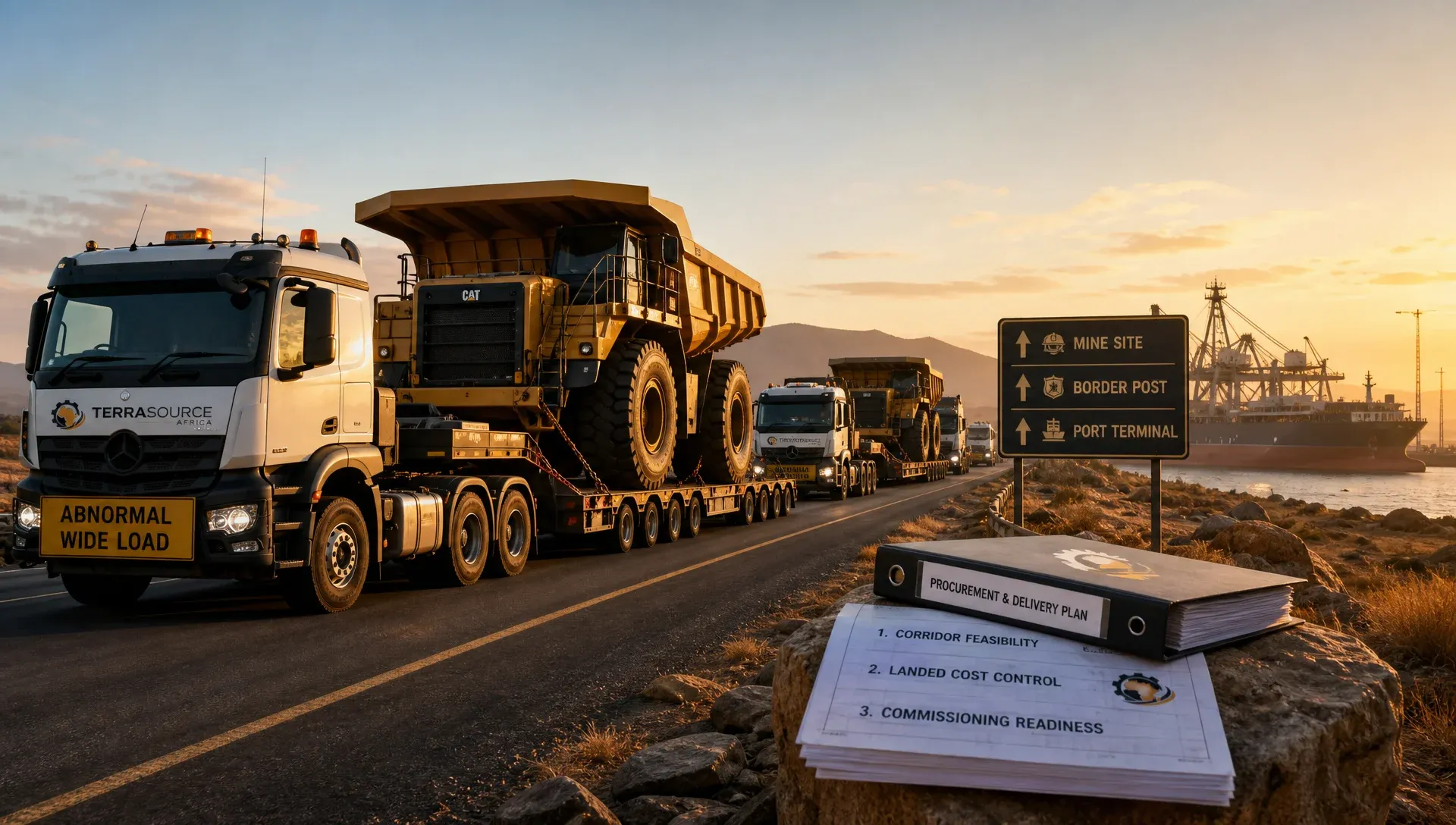
Beyond Unit Price: 3 Procurement Levers Mine Operators Must Control in Africa
Stop letting procurement's unit-price focus derail your mining schedule. Discover the three operational levers mine operators must control to manage corridor risk, guarantee delivery, and own total landed cost in Africa.

Africa's Critical Minerals Boom: Is Your Equipment Strategy Risking It All?
Africa's critical minerals boom is forcing rushed equipment decisions. Learn why a corridor-first procurement strategy is essential to protect project timelines, control landed costs, and avoid catastrophic delays.
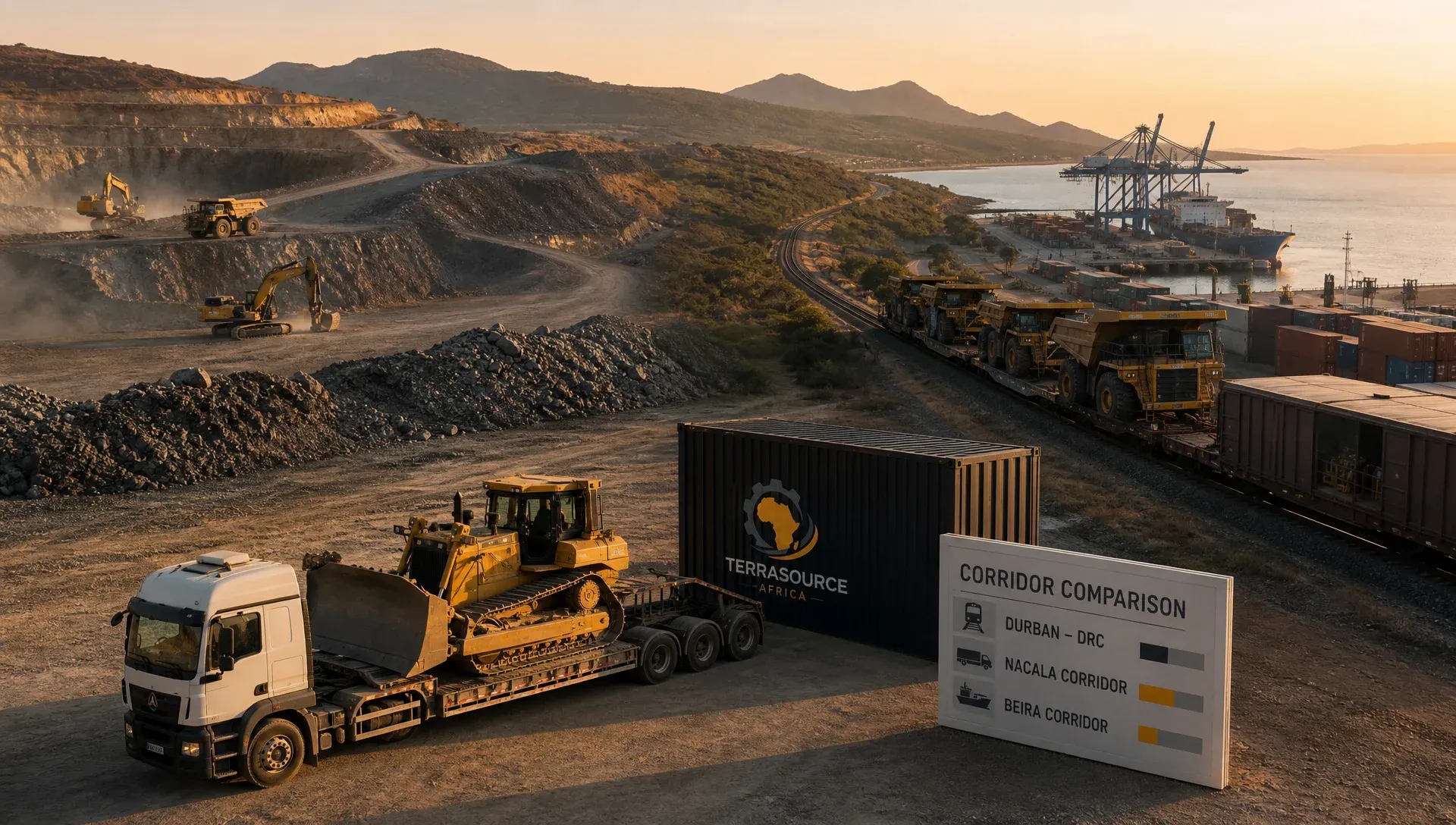
Sourcing for Africa's Top Mining Countries? A Guide to Corridor Risk & Landed Cost
Procuring equipment for top mining countries like the DRC? This guide compares sourcing routes (OEM, dealer, broker) and analyzes corridor risks (Durban-DRC, Nacala, Beira) to help you control total landed cost and avoid project delays.