
.png)
Why Total Delivered Cost Control Matters First. African infrastructure and mining projects are securing unprecedented funding commitments, yet equipment delays still devastate timelines when procurement teams chase unit prices instead of controlling total delivered costs. Total Delivered Cost (TDC) is the all-inclusive price of a product, including the initial purchase price plus all logistics, compliance, and risk-related expenses incurred to get it to its final destination. As private capital mobilization accelerates across the continent, supply chain discipline determines which projects capture their windows and which pay crushing penalties for late equipment arrivals.
The procurement trap is predictable: focus on the cheapest quote, outsource logistics as an afterthought, then absorb massive overruns when equipment sits in port detention or arrives out of compliance. Supply chain strength now decides project success in Africa, while materials risk pressures returns across sectors.
TerraSource Africa delivers commercially controlled sourcing and cross-border delivery for project-critical mobile equipment. Our position is simple: procurement discipline means managing total delivered cost from supplier gate to site handover, not chasing invoice prices that ignore route risk.
The Procurement Trap That Destroys Project Timelines
The recurring pattern isn’t a shortage of equipment quotes, it’s buyer-side blindness to the risk between supplier delivery and site arrival. Standard failures include:
Unchecked supplier credibility: Hours mis-stated, serial provenance missing, service records fabricated, or refurbishment standards ignored until equipment fails pre-commissioning inspection.
Logistics treated as commodity service: General forwarders appointed post-award with zero route strength analysis, no oversize permit strategy, and seasonal constraints ignored until rainy season closures block critical corridors.
Documentation gaps that trigger border delays: Wrong HS codes, rules-of-origin assumptions, carnet versus bond confusion, or unsequenced pre-clearance creating avoidable customs friction.
Payment terms that transfer risk to buyers: Milestones tied to ex-works dates rather than delivery stage-gates, leaving projects exposed when cross-border transit fails or extends beyond contracted windows.
The “bargain” excavator becomes the project’s most expensive line item when it misses mobilization windows, accumulates port storage fees, or arrives without critical commissioning spares.
The Real Cost of Loose Routes and Weak Delivery Control
When route strength and supplier accountability remain uncontrolled, costs compound rapidly:
Timeline penalties: Idle crews burning day-rates, missed shutdown windows, liquidated damages, and lost production directly tied to late equipment arrival.
Port and border leakage: Demurrage charges, container detention, storage fees, scanning costs, escort premiums, and weighbridge penalties after preventable permit failures.
Compliance failures: Insurance claims denied after undocumented route deviations, fines from incorrect declarations, or equipment rejected at borders for non-compliant documentation.
Mechanical exposure: Inadequate pre-shipment preparation, missing spares packages, contamination from poor handling, and transit damage from improper securing protocols.
Currency and tax surprises: FX slippage between payment and delivery, VAT treatment errors, exemptions not validated in advance, and transit bond costs exceeding estimates.
Security and seasonal disruption: Convoy requirements ignored, rainy-season road closures, bridge restrictions, ferry outages, and night-movement bans extending transit windows beyond project tolerance.
In Africa’s current investment climate, with economic expansion momentum building, opportunity costs of delay are rising while supply chain capacity tightens. Projects cannot absorb logistics failures when materials constraints already pressure returns.
Multi-vendor procurement amplifies risk exposure. Diffuse accountability between equipment sellers, freight forwarders, and local agents means no single party owns total delivered outcomes. Project teams carry coordination burden and absorb the full risk stack.
Commercially Controlled Sourcing: The Disciplined Response
Strong procurement positions consolidate sourcing and logistics with single, accountable partners measuring success at site handover, not supplier gates. As earthmoving equipment buyers should compare carefully, core control elements must be established from the start:
Supplier Credibility That Survives Site Inspection
- Serial verification, hour validation, and service history confirmation linked to actual operating environments
- Pre-shipment inspection tied to acceptance criteria, including contamination control and preservation standards
- Spares and tooling packages configured for commissioning plus 90-120 days operations, eliminating first-use failure risk
Route Strength Engineered for Certainty
- Corridor selection modeled against axle loads, bridge constraints, seasonal windows, weighbridge enforcement, and escort capacity
- Port options compared on berth availability, RORO versus LOLO practicality, customs efficiency, and corridor bottleneck history
- Pre-approved oversize permits, transit bonds, and regional compliance sequenced before vessel nomination
Delivery Control With Live Accountability
- Integrated shipping coordination across ocean, port, and road legs with GPS-tracked convoys and vetted driver networks
- Issue management protocols: alternate border crossings, ferry backups, night-movement exemptions, and security procedures
- Stage-gate governance linking supplier readiness, export clearance, discharge windows, permit issuance, and site handover to payment milestones
Commercial Terms That Enforce Discipline
- Payment schedules tied to logistics achievements, not promises
- Contracted liability for demurrage and deviation where partners control delivery legs
- FX and tax planning embedded in schedules with correct Incoterms selection aligning control, risk, and responsibility
- Total delivered cost tracking from quote to handover as a single source of procurement truth
This operating model defines TerraSource Africa: commercially controlled sourcing and cross-border delivery of project-critical mobile equipment with buyer-side clarity from supplier screening to site arrival.
Where Route Risk Bites Hardest: Critical Sectors and Corridors
Mining expansions and brownfield debottlenecking: Shutdown windows and contractor day-rates magnify costs when shovels, ADT fleets, or processing plant equipment arrive late.
EPC civil packages under liquidated damages: Road, rail, and port construction tied to milestone payments cannot absorb equipment delays without severe cashflow stress.
Utility-scale renewables: Commercial operation dates and wheeling arrangements punish late mobilization while tight equipment supply chains make missed windows difficult to recover.
Corridor Examples Where Route Strength Determines Outcomes
Southern corridors: Durban/Richards Bay to Zambia/DRC via Beitbridge or Kazungula; Maputo to Tete - bridge limits, weighbridge enforcement, and night movement restrictions are frequent.
East Africa: Mombasa to Uganda/Rwanda/DRC - ECTS requirements, convoy policies, and rainy-season slope failures on critical stretches.
West Africa: Abidjan/Tema/Lome to Burkina Faso/Mali - border queue variability, security convoy requirements, and axle load enforcement.
Central routes: Walvis Bay to Zambezi/Kasumbalesa - extended stretches with limited recovery options demanding mechanical readiness and strategic spares positioning.
Without explicit scoring of supplier credibility, corridor constraints, seasonal windows, and permit sequencing, you cannot control total delivered cost; you remain exposed to it.
Commercial Discipline: Your Next Steps
Consolidate accountability: Single partner responsible for supplier integrity and cross-border delivery performance.
Enforce stage-gates: Payment milestones tied to logistics achievements, not departure dates.
Map route strength: Choose corridors for delivery certainty, not procurement convenience.
Maintain total delivered cost visibility: Base decisions on complete cost reality, not optimistic quotes.
If you need buyer-side clarity before awarding supply, TerraSource Africa can assess your supplier lineup, corridor options, permit requirements, and commercial structure, then turn that into a route risk assessment and total delivered cost plan aligned to your mobilization timeline.
Read next
Related posts
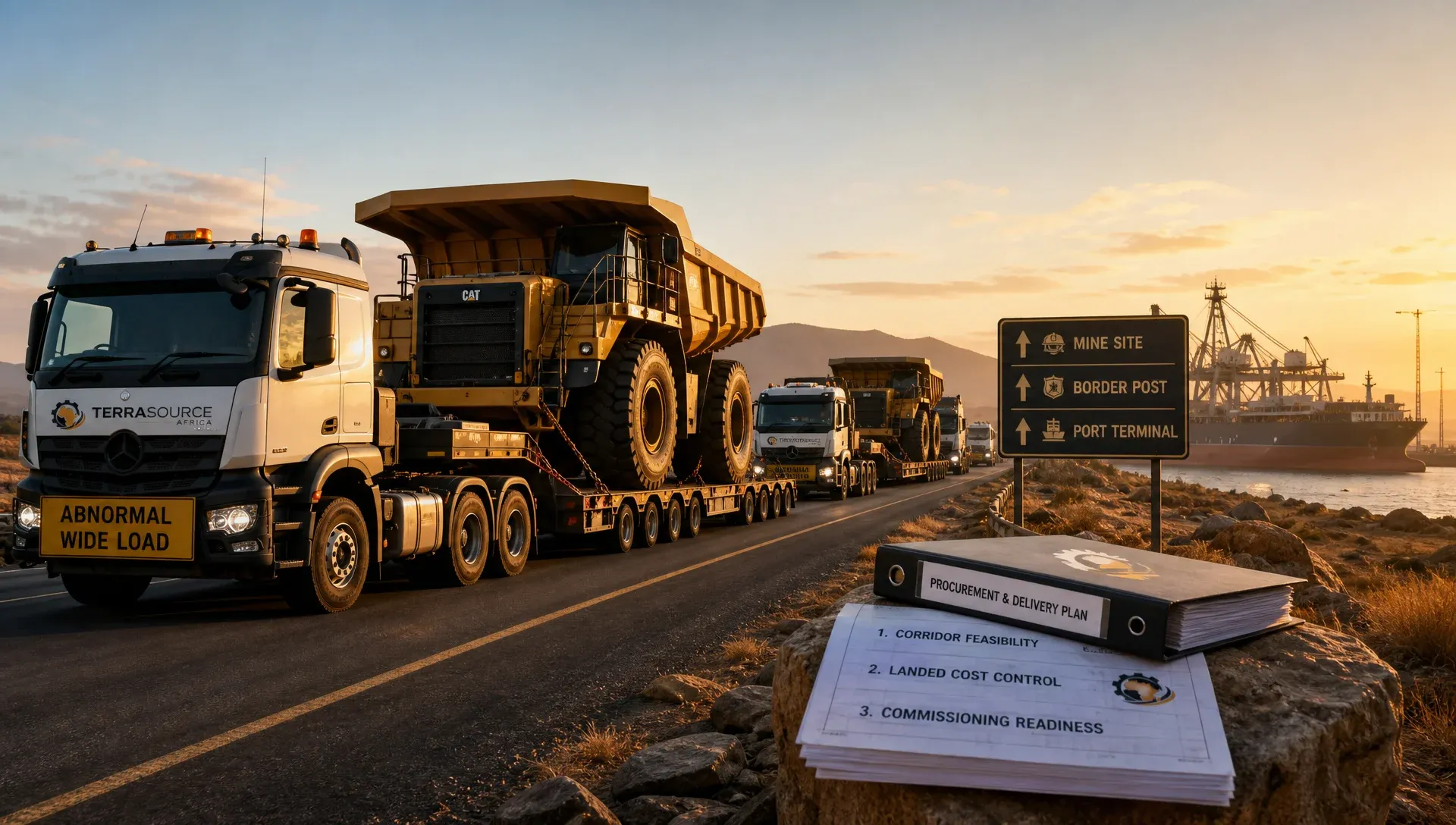
Beyond Unit Price: 3 Procurement Levers Mine Operators Must Control in Africa
Stop letting procurement's unit-price focus derail your mining schedule. Discover the three operational levers mine operators must control to manage corridor risk, guarantee delivery, and own total landed cost in Africa.

Africa's Critical Minerals Boom: Is Your Equipment Strategy Risking It All?
Africa's critical minerals boom is forcing rushed equipment decisions. Learn why a corridor-first procurement strategy is essential to protect project timelines, control landed costs, and avoid catastrophic delays.
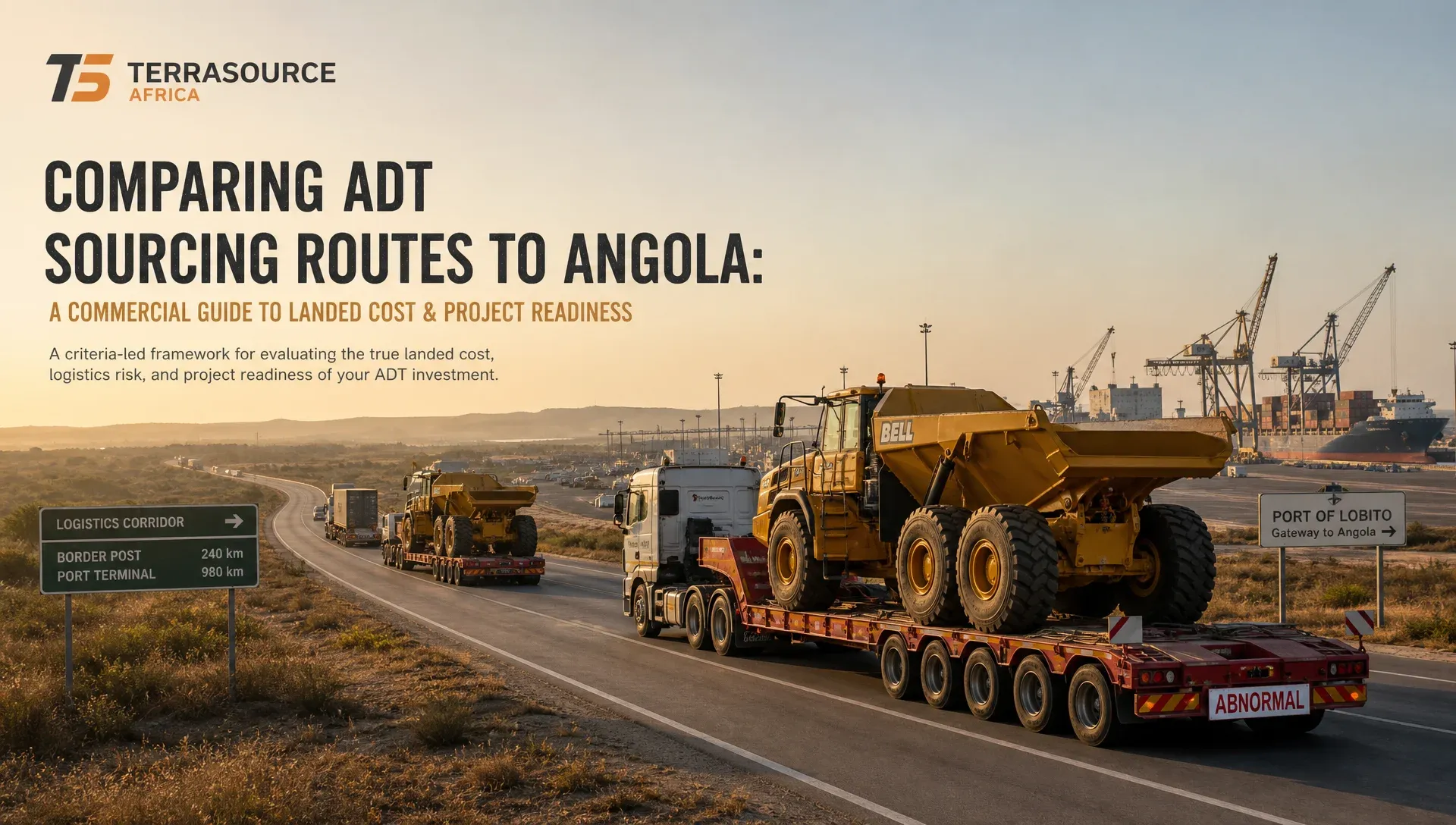
Articulated Dump Truck Angola: Which Sourcing Route Minimizes Project Risk?
Don't let hidden costs derail your Angola project. This guide compares three ADT sourcing routes—OEM, local agent, and integrated partner—to help you calculate true landed cost and manage delivery risk.