
.png)
Machine specifications tell you what equipment can do. Total landed cost and delivery control determine whether it arrives when your project needs it. Across Africa’s mining corridors, the gap between quoted price and actual acquisition cost often exceeds 40% when cross-border logistics, permits, and delivery risks surface late in the process.
Frame the Comparison Around Commercial Reality, Not Machine Features
Before comparing procurement routes, establish measurable criteria that reflect corridor conditions:
Total Landed Cost (TLC) calculation: Base unit price plus preparation (PDI, attachments, tyres), logistics chain (crating, port handling, inland transport, escorts, permits), taxes and duties minus exemptions, plus risk premiums for delays and contingencies. The formula: TLC = Equipment + Preparation + End-to-End Logistics + Regulatory Costs + Risk Buffer.
Delivery timeline certainty: Measure variance, not averages. Request corridor-specific lead times broken down by segment—port dwell, border processing, route restrictions, axle-load verification—with evidence from recent deliveries.
Supply chain control: Identify who holds accountability at each handoff point. Verify Incoterms coverage, liability boundaries, tracking capabilities, and escalation rights from factory gate to site delivery.
Project risk mitigation: Evaluate structured contingency plans covering spare parts availability, rescue equipment, alternative routes, insurance coverage, and recovery protocols for border closures or infrastructure changes.
Corridor context: Africa’s mining infrastructure priorities have shifted toward supply-chain security and delivery control, intensifying competition for logistics capacity on key routes. Price estimates at quotation stage frequently underestimate permit costs, escort requirements, and demurrage exposure.
How Price-Led Routes Perform Against Project Requirements
Price-focused procurement models—direct OEM purchasing, regional dealers, and digital platforms—optimize for initial cost but transfer delivery complexity to buyers.
Direct OEM procurement offers transparent factory pricing, configuration control, and warranty clarity. Units built to specification ship on established OEM logistics lanes with documented engineering standards.
Exposure points include production slot flexibility, export prioritization during capacity constraints, and Incoterms typically ending at FOB or CIF—leaving African inland segments to buyer coordination. Accessory gaps like specialized tyres, fire suppression systems, or ROPS modifications often surface after shipping begins. TLC risk concentrates in demurrage charges and last-mile delivery surprises.
Regional dealer networks provide geographic proximity, established aftersales coverage, and familiarity with national permit processes. Credit terms may offer more flexibility than direct OEM arrangements.
Weaknesses emerge in inventory mismatches across borders, margin stacking on subcontracted logistics, and variable competence with multi-country corridors. Dealer focus remains sell-side rather than buyer-side delivery clarity. TLC inflation occurs through duplicated handling, partial clearances, and storage fees between countries.
Digital brokerage platforms enable rapid unit discovery and competitive pricing, particularly for secondary equipment or spot purchases. Digital coordination adoption is expanding across African industrial supply chains, improving procurement visibility.
Risk factors include supplier credibility variance, asset condition inconsistencies, fragmented logistics requiring buyer integration, and escrow disputes that delay dispatch. Low headline prices often offset through rework costs, extended inspections, and project team idle time.
Hidden cost patterns across price-led routes include route surveys for oversize loads, police escorts and curfew compliance, temporary import bonds, port storage from documentation delays, border storage from weight violations, and preventable re-handling when crating doesn’t match corridor requirements.
Verdict: Price-led routes work for non-critical equipment, single-country moves, or flexible schedules. They underperform when delivery certainty and cross-border control outweigh factory pricing.
What End-to-End Sourcing Partners Change in Practice
End-to-end sourcing partners contract for commercially controlled procurement and cross-border delivery, not just equipment supply. The objective shifts from lowest quoted price to predictable total landed cost with delivery control.
Supplier credibility and sourcing discipline: Multi-vendor sourcing with recent delivery verification and financial standing checks. Condition verification through pre-shipment inspection including photo documentation and serial number confirmation.
Route strength optimization: Corridor benchmarking across Durban-Copperbelt, Walvis Bay, Beira, and Northern Corridor options. Load classification matched to axle limits, convoy regulations, and seasonal bottlenecks.
Commercial structure alignment: Incoterms extended to CIP or DDP where viable. Milestone-based payment schedules. Foreign exchange hedging options. Single contract covering sourcing through delivery to eliminate handoff gaps.
Border readiness preparation: Pre-clearance documentation, bond arrangements, permits, and escort booking completed before vessel arrival. Crating and securing designed specifically for chosen route to prevent rework.
Active delivery control: Live milestone tracking with variance alerts. Recovery protocols including alternate ports, night-movement windows, backup tractors, and split-module strategies.
Commissioning continuity: On-site handover procedures, staged spare parts and tyre packages, warranty registration aligned with actual arrival.
Illustrative comparison: A 100-tonne haul truck sourced with end-to-end control typically moves Durban to Copperbelt in 24-28 days with minimal variance when routed through vetted operators with pre-cleared documentation. The same unit under fragmented contracting averages 45-60 days with 2-3 unplanned cost events. The difference reflects delivery control systems, not market conditions.
Match Procurement Route to Project Requirements
Apply the criteria framework to choose deliberately:
Select OEM direct or regional dealers when: Equipment specifications are standard, delivery remains within single countries, project timelines allow flexibility, and local aftersales support dominates requirements. Negotiate Incoterms to include inland delivery and pre-price permits with escorts.
Consider digital platforms when: Purchasing non-critical or backup units, self-managing inspections is viable, and delivery delays won’t impact production schedules or contract penalties. Protect transactions with escrow arrangements and independent verification.
Choose end-to-end sourcing partners when: Equipment is project-critical, involves cross-border corridors, schedules are constrained, or late delivery penalties are material. Value derives from buyer-side clarity, integrated delivery control, and single-point accountability across sourcing and logistics.
Buyer preparation to compress lead times: Define critical path dates and quantify slip costs through daily burn rates or liquidated damages. Share preferred corridors, site access constraints, and operational windows. Confirm tax exemption status and import entity readiness. Specify attachment requirements and localization needs. Align on Incoterms and payment milestones upfront.
Next step: Schedule a Project Corridor Risk Assessment to pressure-test your current approach against total landed cost, delivery certainty, and risk mitigation criteria, and outline a commercially controlled sourcing strategy for your specific corridor requirements.
Read next
Related posts

Hard-Rock Underground Mining Buyers Should Compare Carefully
A commercially disciplined comparison of hard-rock underground mining and large-scale open-pit mining for African projects: mobile equipment needs, delivery risks, and strategic procurement insights for sourcing managers.
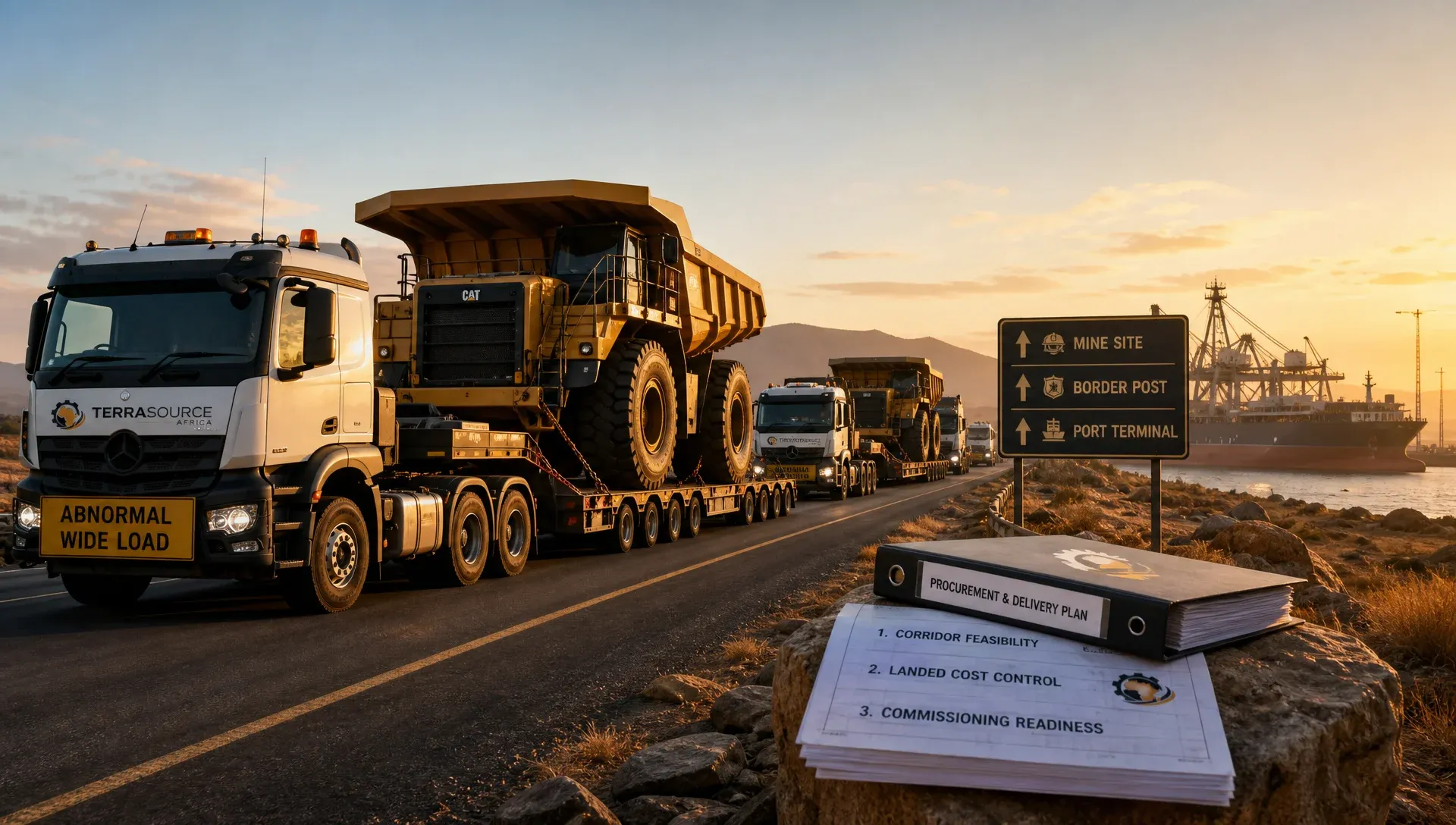
Beyond Unit Price: 3 Procurement Levers Mine Operators Must Control in Africa
Stop letting procurement's unit-price focus derail your mining schedule. Discover the three operational levers mine operators must control to manage corridor risk, guarantee delivery, and own total landed cost in Africa.

Africa's Critical Minerals Boom: Is Your Equipment Strategy Risking It All?
Africa's critical minerals boom is forcing rushed equipment decisions. Learn why a corridor-first procurement strategy is essential to protect project timelines, control landed costs, and avoid catastrophic delays.