
.png)
Procurement teams sourcing mobile equipment for African mining operations face a fundamental challenge: supplier abundance paired with delivery uncertainty. The difference between project success and costly delays often comes down to corridor control, not just equipment availability. This analysis compares four primary sourcing routes across Africa’s critical mining corridors—examining where each approach delivers value and where it exposes commercial risk.
The Criteria That Actually Drive Sourcing Decisions
Before comparing suppliers, establish clarity on the operational criteria that determine project outcomes:
Route strength and border choreography: Understand the true friction points across major corridors. Beitbridge, Kazungula, Chirundu, and Kasumbalesa on the North-South route; Nyamapanda/Machipanda for Beira access; Dedza/Chipata on Nacala; and Ngoma/Katima Mulilo on the Walvis Bay-Trans Caprivi corridor. Slot bookings, escort availability, axle limits, and seasonal restrictions determine whether delivery plans survive first contact with corridor realities.
Delivery accountability: Who owns the complete delivery chain from port to site? Split responsibility—where sellers handle ocean freight but buyers manage inland transport—multiplies demurrage risk and creates liability gaps when equipment sits detained at border crossings.
Supplier credibility and support infrastructure: Can the supplier stage spare parts, deploy technicians with valid cross-border visas, and activate software licenses immediately upon commissioning? In copper and cobalt operations where uptime directly impacts offtake schedules, after-sales capability becomes a commercial imperative.
Lead-time certainty versus corridor capacity: Factory availability means little if corridor constraints create bottlenecks. Recent analysis of Africa’s mining infrastructure highlights uneven capacity and procedural variability across key transport routes that directly impact project timelines.
Total landed cost beyond unit pricing: Include pre-export inspection, duties and exemptions, VAT deferment, port storage, abnormal load permits, police escorts, route deviations, weighbridge delays, cross-dock handling, insurance extensions, and foreign exchange exposure across ZAR, MWK, ZMW, and CDF currency legs.
Contract discipline: Incoterms that align with risk tolerance (DAP site versus FCA/FOB), enforceable warranties in the jurisdiction of performance, liquidated damages for commissioning delays, and acceptance criteria tied to equipment availability rather than physical delivery alone.
The stakes are particularly high given the Democratic Republic of Congo’s strategic position in global cobalt supply chains. DRC’s cobalt concentration creates supply chain leverage that increases corridor pressure and escalates the commercial cost of delivery failures.
Where Direct-from-OEM Sourcing Delivers Value
Direct manufacturer sourcing provides clear advantages in specific contexts while exposing predictable risks in others.
OEM sourcing strengths:
- Engineering integrity through build-to-specification processes, factory testing, and complete software entitlements
- Warranty leverage with clean coverage terms and established recall pathways
- Lifecycle integration including telematics systems and planned maintenance programs locked at order stage
Where OEM sourcing creates exposure:
- Extended lead times with factory slots and shipping windows that can push commissioning timelines by quarters rather than weeks
- Delivery fragmentation where OEM quotes typically end at FCA/FOB terms, transferring inland transport risk to buyers
- Corridor compatibility issues when large modules cannot be componentized, creating escort bottlenecks during peak periods on routes like Beitbridge-Chirundu-Kasumbalesa
- Regional support variability where weak dealer networks in Zambia or DRC extend warranty response times
Optimal OEM sourcing scenarios:
- Greenfield projects with secured funding, extended development timelines, and requirements for technology standardization
- Corridors with established inland delivery control, such as OEM commitment to DAP site terms on North-South routes with pre-arranged escorts and bonded carriers
When to avoid OEM direct sourcing:
- Brownfield replacement projects with fixed shutdown windows
- Sites dependent on wet-season transport across Nacala or Beira corridors where axle load restrictions and weather constraints require tactical re-routing and rapid componentization
When Regional Dealers Versus Independent Brokers Make Commercial Sense
These sourcing routes are often conflated but operate with fundamentally different incentive structures and corridor capabilities.
Regional dealer advantages:
- Route familiarity with established parts depots in South Africa, Zambia, and DRC that reduce spare parts lead times
- Delivery control options including willingness to quote DDP/DAP to site with pre-clearance and bonded transport on Durban-DRC and Beira-Tete routes
- Warranty continuity through dealer-administered claims processes that reduce downtime disputes
Regional dealer trade-offs:
- Allocation constraints where priority goes to framework agreement clients, leaving spot buyers facing extended delays
- Brand limitations that may exclude alternatives with superior corridor compatibility
- Pricing premiums that reflect availability and support—justified only when service-level guarantees are contractually enforceable
Independent broker strengths:
- Sourcing speed for late-model used units or excess inventory when OEM and dealer allocations are constrained
- Capital efficiency through lower acquisition costs on used or refurbished assets for interim capacity requirements
Independent broker risks:
- Supplier credibility exposure including condition misrepresentation, documentation gaps, or serial number irregularities that can result in border detention
- Delivery fragmentation through reliance on ad-hoc transport providers without established route strength or escort scheduling
- Warranty limitations with non-OEM coverage that transfers downtime risk to buyers
Risk mitigation for broker sourcing:
- Independent inspection with serial number verification and OEM system compatibility checks
- Escrow arrangements with staged payments tied to border clearance milestones
- Pre-cleared documentation and bonded transit arranged independently rather than through broker networks
What Commercially Controlled Sourcing Looks Like
Effective procurement decisions extend beyond supplier selection to encompass corridor-specific delivery programs with enforceable outcomes.
Characteristics of disciplined sourcing:
- Single point of accountability for ocean and inland delivery with DAP site as standard rather than FOB port terms
- Corridor-specific execution plans with pre-booked transport slots and contingency routes
- Contract structures that protect buyers through milestone payments tied to border clearance and site arrival, liquidated damages for commissioning delays, and warranty acceptance linked to equipment availability
- Support infrastructure assurance including spare parts positioning, technician visa processing, and software activation before equipment dispatch
Corridor-specific considerations:
- Durban-DRC (North-South): Police escort and weighbridge scheduling 2-3 weeks in advance, avoidance of month-end customs processing peaks, componentization strategies for abnormal load classifications
- Nacala: Containerized modules for Malawi and Zambia segments, wet-season buffer periods, verification of current rail capacity allocations
- Beira: Strong option for Tete and Zambezi Valley access with confirmed bridge load limits and nighttime movement protocols for abnormal loads
- Walvis Bay-Trans Caprivi: Lower congestion with consistent border procedures, extended transit planning for long-haul segments
Route selection by project context:
- Long-horizon standardized fleets: Direct-from-OEM or regional dealer with contracted DAP site delivery and enforceable support service levels
- Time-critical mobilizations: Specialist partner with demonstrated route strength and integrated delivery control
- Opportunistic single-unit requirements: Independent broker only with independent inspection, escrow protection, and separate corridor management
For procurement teams evaluating Durban-DRC against Nacala or Beira corridors—particularly when decisions appear cost-driven rather than risk-controlled—a Project Corridor Feasibility Briefing can translate project scope, corridor constraints, and supplier options into delivery-controlled execution plans with buyer-side clarity.
TerraSource Africa delivers commercially controlled sourcing and integrated delivery management for project-critical mobile equipment across African mining corridors, providing procurement discipline that prioritizes total landed risk over unit pricing alone.
Read next
Related posts

Top Open-Pit Mining Countries in Africa and Corridor Risk that Matter
Don't just rank the top mining countries in Africa by geology. This guide reframes the decision for open-pit mining success around equipment delivery risk. We compare SADC vs. Atlantic corridors on infrastructure, customs, and supplier depth to help you de-risk your project schedule and budget.
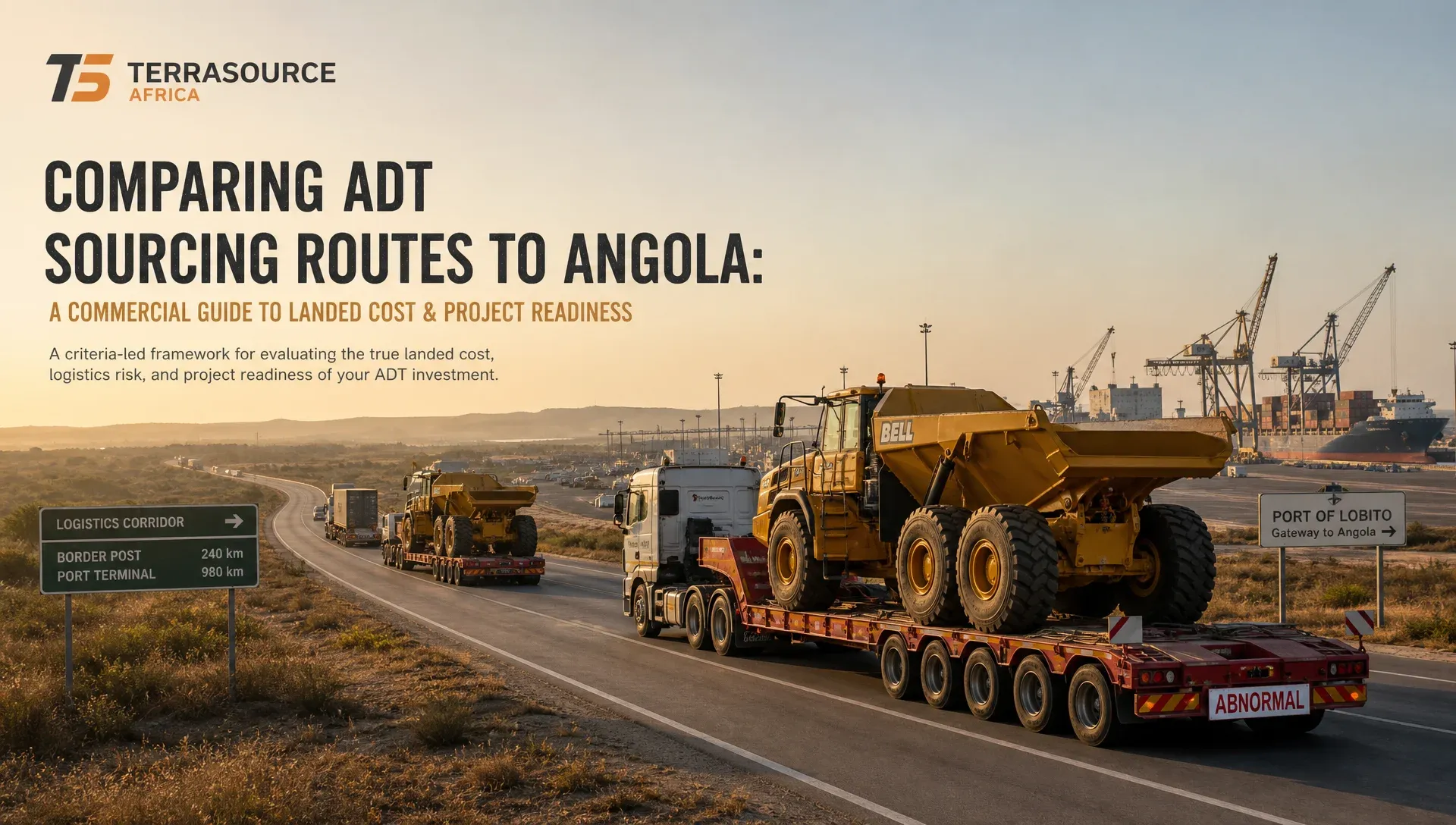
Articulated Dump Truck Angola: Which Sourcing Route Minimizes Project Risk?
Don't let hidden costs derail your Angola project. This guide compares three ADT sourcing routes—OEM, local agent, and integrated partner—to help you calculate true landed cost and manage delivery risk.

Procuring Mobile Mining Equipment in Africa: 4 Routes and Their Hidden Costs
A comparison of four procurement models for mobile mining equipment in Africa, focusing on total landed cost, delivery certainty, and the hidden risks that can inflate project costs by over 40%.