
.png)
The corridor decides your project timeline before you sign any purchase order. In African equipment procurement, route strength trumps unit price—because a “cheap” excavator stuck at Beitbridge for five days costs more than an expensive one that clears customs in six hours.
Why This Decision Keeps Breaking Down
Most procurement teams treat equipment sourcing and corridor logistics as separate, sequential tasks. The standard sequence: collect three quotes, select based on price and availability, then ask logistics to “make it happen.” This model collapses under African cross-border delivery pressure.
Commercial pressure points driving bad procurement decisions:
- Unit price targets override total landed cost analysis
- “Availability” gets confused with deliverability
- Supplier access is mistaken for supplier control
- Corridor planning happens after deposit commitment
- Project mobilisation dates are set without route intelligence
The infrastructure reality compounds these mistakes. Africa’s trade ambitions continue to face infrastructure gaps, customs inefficiencies, and logistics bottlenecks that punish late-stage logistics planning.
Procurement discipline starts with a different question: What is the risk-adjusted cost and lead time to put this specific machine operational on-site by the deadline—on a route we control?
The Cost of a Loose Route
When corridor planning is deferred, costs accumulate silently and timelines slip in days, not hours. The failure cascade typically follows this pattern:
Border friction tax: Abnormal permits, police escorts, weekend embargoes, ad hoc “fees,” and pre-clearance gaps stack up across Beitbridge, Chirundu, and Kasumbalesa. Each delay triggers downstream costs.
Equipment idle burn: OEM technician standby, contractor crews, fuel, accommodation, and crane hire all wait on the delayed truck. Daily standby rates compound quickly.
Rate re-quote spiral: Carriers reprice after discovering true dimensions, axle loads, or last-minute route changes. Initial transport quotes become meaningless.
Storage and demurrage: Port and yard delays while paperwork, inspections, or duties are resolved. Demurrage clocks run regardless of whose fault the delay is.
Attachment misalignment: Buckets, rippers, and GET routed separately, arriving out of sequence, stalling commissioning by weeks.
Security and loss exposure: Unsecured staging or unplanned night stops introduce theft and damage risks that insurance may not cover.
Timeline exposure translates directly into budget risk. Every day late on a mine pre-strip or concrete pour compounds opportunity cost and liquidated damages. Unit price is not the real cost—availability does not equal deliverability.
If your requirement involves high-risk crossings like Beitbridge or Kasumbalesa, request a corridor and landed-cost assessment before you commit.
What a Controlled Route Changes
A commercially controlled sourcing model integrates equipment selection with corridor design before any deposit. The result is buyer-side clarity on what can be delivered, by when, and under which terms.
Route-first scoping: Model multiple corridors, seasonality, and axle-load constraints against your site deadline before supplier selection. This reverses the typical sequence.
Supplier credibility screening: Verify export readiness, VIN/serial integrity, lien status, and spares condition. Insist on on-ramp milestones you control.
Incoterms with teeth: Align payment terms to site acceptance (or a controlled staging yard), not a distant port gate where you lose leverage.
Pre-clearance and permits: Abnormal load permitting, police escort bookings, and bond arrangements are secured before deposit, not after.
Mode agility: Evaluate road-only versus road-rail transfers where they de-risk transit. Rail can neutralise weight, security, or road embargo risks when engineered correctly, a shift increasingly validated by large logistics operators.
Load engineering: Lowbed selection, detachable goosenecks, bridge clearance checks, convoy spacing, and night-stop security specified per segment.
Attachment choreography: Consolidate buckets, GET, and auxiliary tanks to arrive with the carrier machine. Define commissioning sequence and on-site cranage requirements.
Control points and reporting: GPS and document checkpoints fixed at borders and yards. Exceptions trigger predefined reroute rules.
Buyer payoff: predictable mobilisation date with buffer ownership, landed-cost certainty built from transparent route costs, fewer re-quotes, less idle burn, higher delivery control.
How It Plays Out in Real Corridors
Below are condensed field patterns for routes that repeatedly test project-critical mobile equipment delivery.
Beitbridge (RSA–Zimbabwe) to Zambia/DRC
Risk profile: Congestion spikes, weekend/holiday restrictions, and document mismatch create multi-day holds. Special focus needed on abnormal permits and transit bonds.
Control measures: Pre-clear with dual brokers. Time departures to avoid peak crossing windows. Split components to keep prime mover legal on axle loads. Secure guarded night stops north of the bridge.
Commercial effect: A “cheaper” ex-Gauteng machine can land later and cost more than a higher-priced unit staged via less congested ports when idle burn and escorts are factored.
Kasumbalesa (Zambia–DRC) into Copperbelt and Lualaba
Risk profile: Long queues, shifting local controls, and variable enforcement. High exposure for wide/overweight lowbeds on final approach.
Control measures: Stage at Ndola/Kitwe yards. Pre-book escorts. Consider rail handoff for ultra-heavy or security-sensitive assets into Kolwezi. Align delivery window with plant shutdowns to ensure immediate offload.
Commercial effect: Availability in South Africa does not equal deliverability into the DRC. Corridor strength dictates the real schedule.
Nacala and Beira (Mozambique) into Malawi/Zambia Interior
Risk profile: Weather and port handling variability. Inland road geometry challenges for long/wide loads.
Control measures: Select port based on current berth schedule and abnormal permit lead times. Verify bridge clearances on inland legs. Pre-position recovery and escort teams for mountain passes.
Commercial effect: Slightly longer sea leg can outperform Durban road congestion when route strength and delivery control are higher.
Walvis Bay (Namibia) to Zambezi/Copperbelt
Risk profile: Longer distance but typically smoother border processes. Abnormal permit timing is the swing factor.
Control measures: Build permit lead time into supplier commitment. Use convoy plans with vetted night stops. Keep attachments consolidated to avoid a second, slower border run.
Commercial effect: The corridor can unlock earlier on-site dates despite extra kilometres, reducing total landed cost compared to “shorter” but slower options.
Route Strength Checklist: Ask These Before You Commit
- Which corridor delivers the earliest credible on-site date under current border conditions?
- What are the abnormal permit, police escort, and pre-clearance lead times per border, and who controls them?
- Where are the guarded staging yards, and how are attachments consolidated?
- What are the carrier’s axle loads, bridge clearances, and convoy rules per segment?
- What is the plan if Beitbridge or Kasumbalesa locks up for 48–72 hours?
- Which Incoterm aligns payment to delivery control, not to a distant hand-off?
- What’s the demurrage and storage exposure at each choke point, and who owns it?
- Is rail or sea-plus-road a viable alternative this season, and what contract terms protect the switch?
- How are supplier credibility, export readiness, and lien status verified before deposit?
- What are the go/no-go gates from quote to on-site acceptance?
If you need a side-by-side comparison of procurement approaches, see our breakdown of the four common routes and their hidden costs.
For buyers facing near-term mobilisation with cross-border exposure, schedule a Project Corridor Risk Assessment to test your current plan against route intelligence and landed-cost control. Need a deeper dive by specific country? Our corridor risk and landed-cost guide for top mining markets can help frame the decision.
TerraSource Africa is a commercially disciplined sourcing and delivery partner for project-critical mobile equipment across African project corridors. We operate with procurement discipline, route strength, and delivery control so buyers can commit with clarity.
Next step: Submit an equipment requirement with your target on-site date and destination. If corridor risk is material, request a corridor and landed-cost assessment.
Read next
Related posts
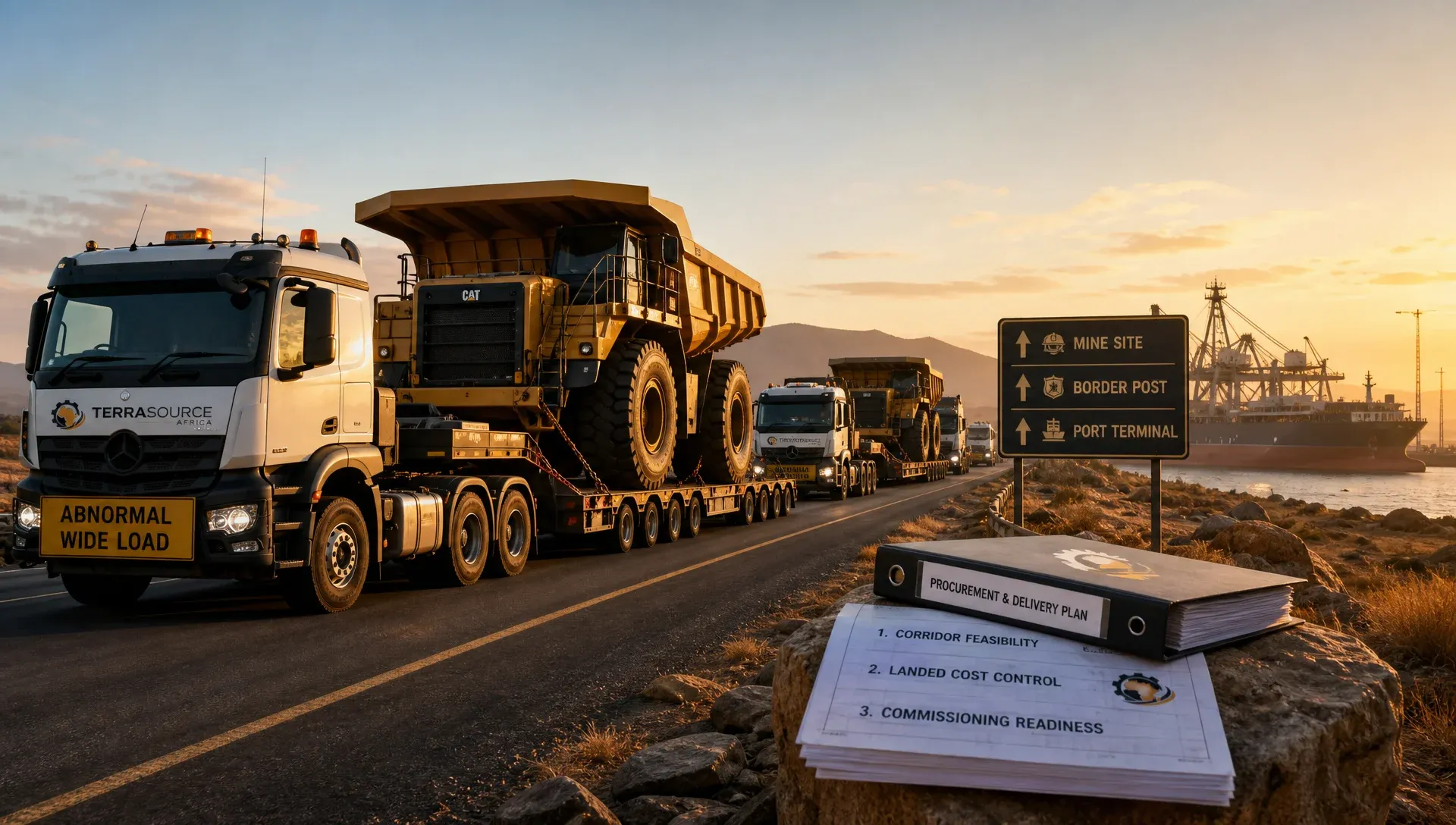
Beyond Unit Price: 3 Procurement Levers Mine Operators Must Control in Africa
Stop letting procurement's unit-price focus derail your mining schedule. Discover the three operational levers mine operators must control to manage corridor risk, guarantee delivery, and own total landed cost in Africa.
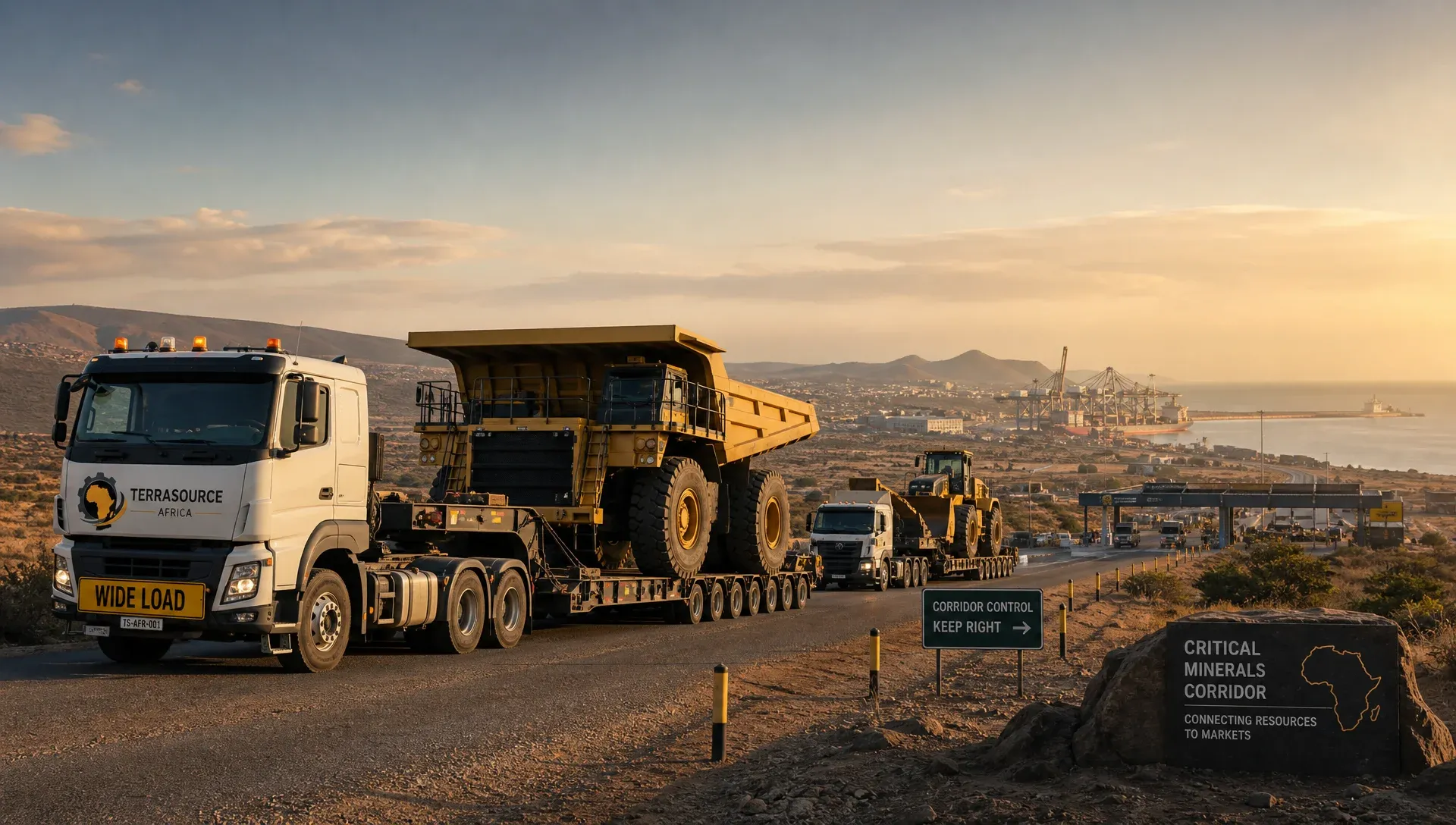
Africa's Critical Minerals Boom: Is Your Equipment Strategy Risking It All?
Africa's critical minerals boom is forcing rushed equipment decisions. Learn why a corridor-first procurement strategy is essential to protect project timelines, control landed costs, and avoid catastrophic delays.
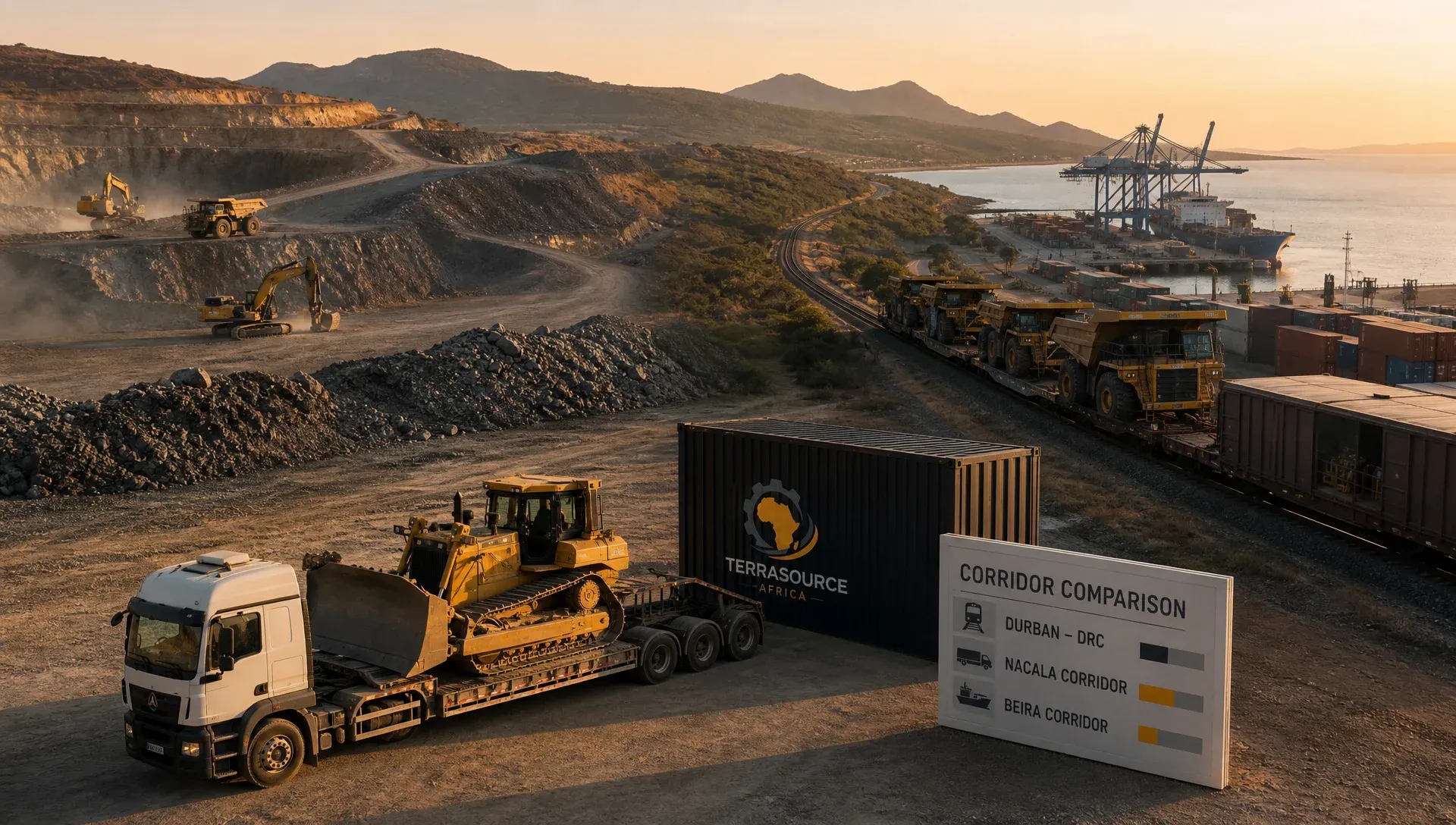
Sourcing for Africa's Top Mining Countries? A Guide to Corridor Risk & Landed Cost
Procuring equipment for top mining countries like the DRC? This guide compares sourcing routes (OEM, dealer, broker) and analyzes corridor risks (Durban-DRC, Nacala, Beira) to help you control total landed cost and avoid project delays.