
.png)
Open-pit mining success in Africa depends more on equipment route strength than ore body size. While investment conferences like Mining Indaba now emphasize turning partnerships into practical delivery outcomes, procurement teams need frameworks that move beyond geological potential to evaluate corridor realities. This guide compares Africa’s primary mining regions through the lens of equipment sourcing routes, delivery control, and the commercial factors that determine whether project-critical mobile equipment arrives on schedule and within budget.
Frame corridor comparison through delivery control metrics
Before ranking jurisdictions, establish criteria that reflect route strength and supplier credibility rather than transit time averages.
Route infrastructure and seasonal reliability
- Port capabilities for heavy equipment (RoRo berths, breakbulk capacity, lifting limits, hazmat storage for batteries and hydraulic fluids)
- Road geometry for abnormal loads including bridge clearances, axle load limits, and wet-season accessibility windows
Customs and border predictability
- Pre-clearance procedures, bonded transit options, inspection protocols, abnormal-load permitting timelines, and escort coordination
In-country supplier credibility
- OEM dealer presence, field technician coverage, parts inventory depth, warranty processing discipline, and emergency equipment availability
Delivery control mechanisms
- Direct port discharge options, secure staging facilities, route survey access, convoy planning capabilities, movement restrictions, and escort availability
Commercial and cashflow considerations
- Port fees, border charges, escort costs, convoy delays, assembly expenses, demurrage exposure, and currency risks
Schedule confidence distributions
- P50/P80/P95 delivery timeframes rather than optimistic averages; variance drivers and mitigation options
Assembly and commissioning practicality
- Port versus inland assembly options, crane access, technician mobilization, tooling availability, and quality assurance protocols
Compliance and community factors
- Local content requirements, movement curfews, stakeholder approvals, security protocols, and corridor-specific regulations
Weight these factors according to project constraints. Immovable first-dig dates prioritize schedule confidence over freight rates. Tight working capital emphasizes bonded transit and duty staging options. This represents procurement discipline, not logistics improvisation.
Southern Africa corridors: when SADC routes deliver superior control
Southern Africa’s established mining corridors—routing through South African, Namibian, and Mozambican ports into Botswana, Namibia, Zimbabwe, Zambia, and southern DRC—often provide the strongest delivery control for inland projects.
Where Southern Africa corridors excel
Supplier ecosystem maturity Deep OEM dealer networks with component rebuilding capabilities, extensive technician coverage, and established warranty processing across SADC markets create reliable post-delivery support.
Corridor infrastructure and permitting Established abnormal-load frameworks with documented procedures, consistent escort availability, and repeatable cross-border processes reduce execution uncertainty.
Port diversity and capability Multiple viable options including Durban/Richards Bay for high-frequency breakbulk, Walvis Bay for congestion-free operations, and Maputo/Beira for eastern corridor access.
Enhanced delivery control Access to professional route surveys, secure border staging facilities, bonded transit arrangements, and reliable convoy coordination.
Assembly and commissioning efficiency Readily available crane capacity, controlled assembly environments, specialized tooling, and structured pre-delivery inspection processes.
Commercial tradeoffs to consider
Port congestion at major facilities can create storage and demurrage spikes without early document preparation and trucking slot reservations. High-volume border crossings may experience queuing without scheduled night-move windows and holiday planning. Layered cost structures including road tolls, escort fees, and clearance charges require careful sequencing to prevent idle-time penalties.
Optimal applications
- Botswana and Namibian interior projects via Walvis Bay with sealed highway access and predictable escort services
- Zimbabwe and central Zambian operations through Durban/Richards Bay utilizing established marshaling facilities
- Southern DRC/Katanga deliveries via Zambian corridors with bonded transit and strict convoy protocols
- Heavy equipment classes (80-150t excavators, rigid dump trucks, D10/D11 dozers) moving as breakbulk with partial disassembly
Commercial advantage Highest P80 schedule reliability for inland SADC destinations and strongest environment for commercially controlled sourcing when projects cannot tolerate first-dig delays.
West and Central Atlantic routes: where proximity creates opportunity
West and Central African ports—including Ghana’s Tema, Côte d’Ivoire’s Abidjan, Senegal’s Dakar, and Central African facilities—offer advantages for coastal projects and selected inland deliveries with disciplined seasonal planning.
Where Atlantic corridors compete effectively
Geographic proximity advantages Shorter ocean transit from European and North American suppliers reduces handoffs and shipping costs for coastal operations.
Improving port capabilities Growing breakbulk and project cargo capacity at Tema, Abidjan, Dakar, and Takoradi with increasing operational consistency.
Regional dealer networks Strengthening OEM presence in Ghana and Côte d’Ivoire improving parts availability and field response capabilities.
Critical limitations to price in
Inland Sahel deliveries face multi-border complexity, seasonal road restrictions, mandatory convoy requirements, and security curfews. Corridor specialist capacity remains limited outside coastal hubs, creating pricing volatility and extended lead times during peak project periods. Central African routes west of DRC involve challenging bridge crossings, river transits, and axle restrictions requiring extensive disassembly and inland reassembly.
Strategic applications
- Coastal operations in Ghana, Côte d’Ivoire, Senegal, and Guinea where proximity and local dealer support enable faster commissioning
- Sahel interior projects with pre-cleared bonds, coordinated convoys, and strict wet-season cutoffs
- DRC-West via Matadi and Congo-Brazzaville via Pointe-Noire requiring careful road geometry planning and increased assembly budgets
Commercial positioning Best choice for coastal or near-coastal mines with verified local supplier support. Interior projects remain viable only with locked delivery control measures including pre-clearance, convoy coordination, staging facilities, and weather window contracts.
Convert corridor analysis into sourcing decisions
Effective sourcing decisions translate corridor realities into buyer-side clarity and firm delivery control mechanisms.
Start with project constraints, not supplier quotes Establish non-negotiable first-dig dates, cashflow windows, and safety parameters for night movements and convoy operations. Set P80 delivery targets for each equipment category.
Validate supplier credibility early Verify dealer technician headcount, parts inventory practices, loaner equipment availability, and warranty service level agreements. Choose between OEM-direct and specialist partner approaches based on risk assessment rather than initial pricing (see OEM vs. Specialist Partner for African Equipment Procurement: A Risk-Based Guide).
Select corridors by variance, not averages Model P50/P80/P95 delivery distributions by route and season. Choose the corridor with lowest variance while meeting cost and compliance requirements.
Engineer assembly and commissioning into route selection Define port versus inland disassembly requirements, reassembly locations, crane specifications, tooling needs, and quality assurance checkpoints.
Pre-book critical control mechanisms Secure staging facilities, escort services, clearance procedures, border crossing slots, and contingency transport. Design convoy schedules around customs processing and movement restrictions.
Phase delivery around production-critical equipment Prioritize dozers, excavators, and primary haulers for initial delivery phases. Schedule ancillary equipment after ore movement capability is established (reference How to Choose Project-Critical Earth-Moving Equipment for African Corridors for equipment prioritization strategies).
Route selection framework
Choose Southern Africa corridors when:
- Projects are located in SADC countries or southern DRC
- Schedule certainty is paramount to project success
- Deep heavy-haul, assembly, and dealer capacity pools are required
Choose West/Central Atlantic corridors when:
- Projects are coastal or near-coastal in Ghana, Côte d’Ivoire, Senegal, or Guinea
- Local supplier credibility is demonstrably strong
- For interior Sahel deliveries, only with bonded pre-clearance, convoy plans, and dry-season delivery windows contractually secured
Schedule a Project Corridor Briefing with TerraSource Africa to validate route assumptions, supplier coverage, and delivery control mechanisms before capital commitment. TerraSource Africa is a commercially disciplined sourcing and delivery partner for project-critical mobile equipment across African project corridors.
Read next
Related posts

Africa's Critical Minerals Boom: Is Your Equipment Strategy Risking It All?
Africa's critical minerals boom is forcing rushed equipment decisions. Learn why a corridor-first procurement strategy is essential to protect project timelines, control landed costs, and avoid catastrophic delays.
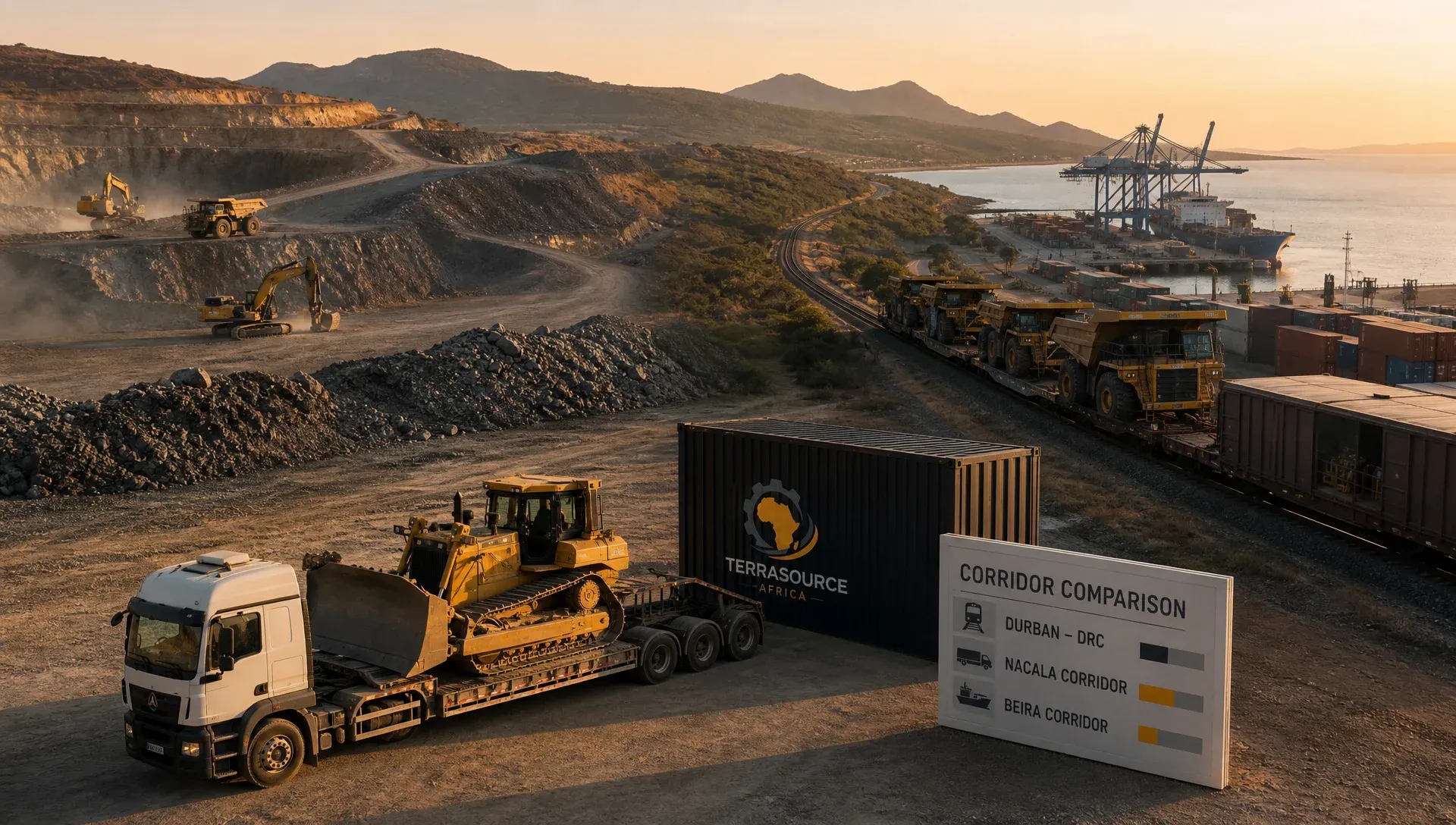
Sourcing for Africa's Top Mining Countries? A Guide to Corridor Risk & Landed Cost
Procuring equipment for top mining countries like the DRC? This guide compares sourcing routes (OEM, dealer, broker) and analyzes corridor risks (Durban-DRC, Nacala, Beira) to help you control total landed cost and avoid project delays.

Hard-Rock Underground Mining Buyers Should Compare Carefully
A commercially disciplined comparison of hard-rock underground mining and large-scale open-pit mining for African projects: mobile equipment needs, delivery risks, and strategic procurement insights for sourcing managers.