
.png)
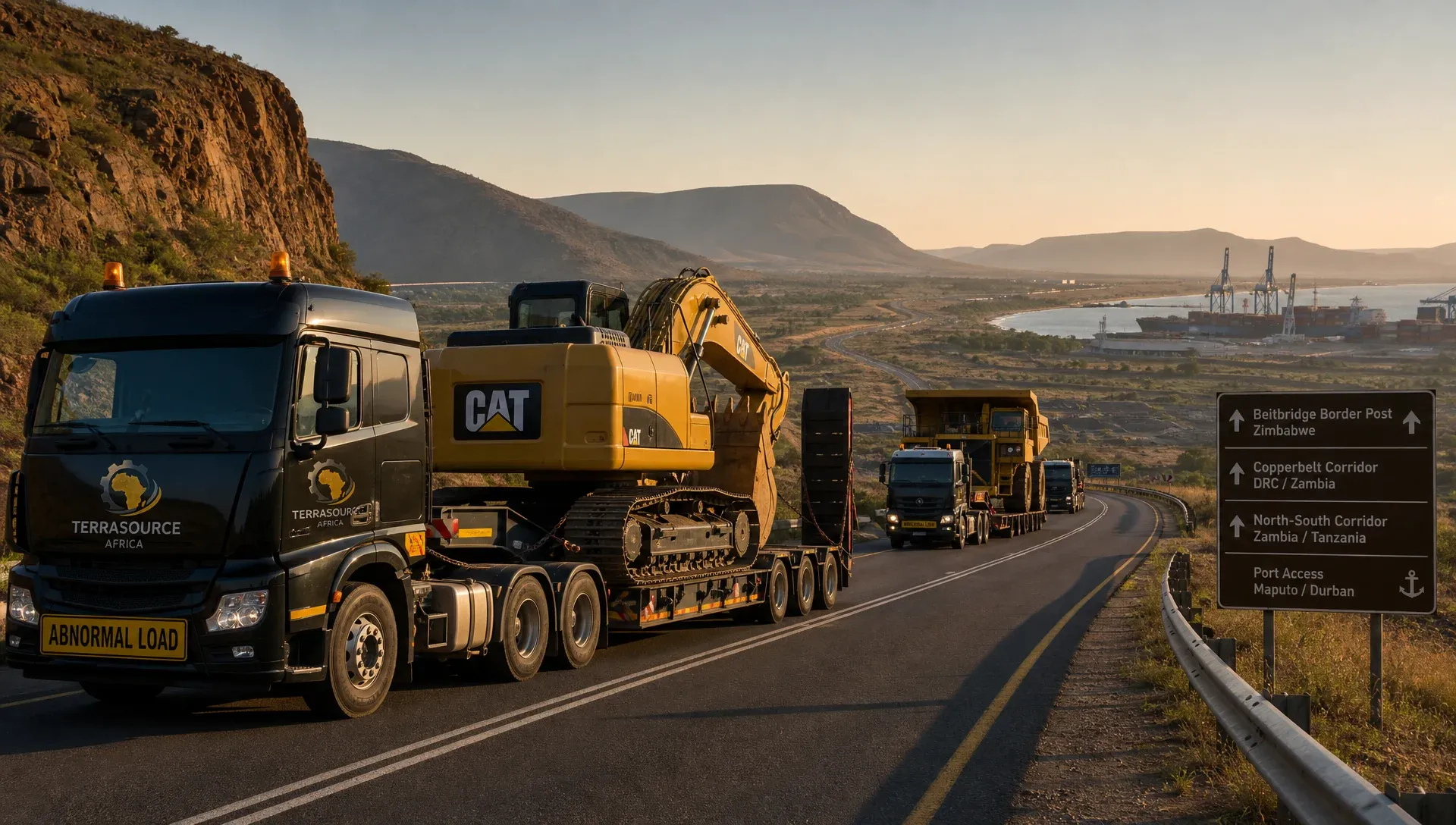
The billion-dollar question isn’t which African country mines the most copper or gold. It’s whether your excavator will clear customs at Kasumbalesa on schedule, or if your haul trucks will make it through Beitbridge before the rainy season shuts down oversize movements. Country-level risk assessments miss the commercial reality: project success depends on corridor control, not mineral wealth rankings.
The Real Procurement Pressure: Route Control Under Time Constraints
Procurement managers face a brutal equation: deliver project-critical mobile equipment within compressed mobilization windows while managing cross-border unpredictability. Three forces intensify this pressure:
Compressed production schedules: Pre-strip, ramp-up, and tie-in timelines put fixed dates on first production. Miss the window and contractor standby costs, lost ore revenue, and crane rescheduling expenses compound daily.
Cross-border volatility: Abnormal-load permits, customs procedures, axle-load enforcement, and police-escort availability shift by corridor and season. What worked last quarter may not work next month.
Supplier credibility gaps: Equipment that appears cost-effective ex-works becomes expensive when poor documentation, incorrect dismantling, or weak route planning creates border delays.
This demands procurement discipline focused on route strength and delivery control, not just unit pricing or abstract country ratings.
Where Commercial Damage Accumulates: The Hidden Costs of Route Weakness
Project bleeding rarely starts at the border crossing. It begins during the RFQ process when route considerations take second place to headline pricing.
EXW pricing illusions: Ex-works quotes hide true costs—inland freight, dismantling, crating, escorts, permits, and risk premiums. Apparent savings become uncontrolled change orders during execution.
Route-last supplier selection: Choosing suppliers first, then forcing route solutions, creates compromises—suboptimal port selection, avoidable oversize challenges, or missed escort windows.
Documentation gaps: Incorrect tariff classifications, missing pre-shipment inspections, or weak transit bond management convert into unplanned dwell time and storage fees at critical checkpoints.
Abnormal-load misalignment: Failing to engineer dismantling against corridor height and width constraints triggers last-minute port modifications, additional crane time, and fresh permit cycles.
Multi-currency exposure: Freight quotes and customs disbursements across multiple currencies create budget volatility when payment milestones and hedging strategies aren’t synchronized.
Delay costs compound exponentially. A single week’s slip on a primary excavator cascades into standby charges for haul trucks, drill-and-blast crews, and crusher commissioning—before factoring reputational damage with project owners.
Commercially Controlled Corridors: The Disciplined Response
A controlled corridor approach transforms procurement risk into manageable rules through systematic delivery control:
Corridor-first RFQ design: Begin with destination requirements and viable routes. Price to DAP/DDP terms including specified routing, dismantling plans, escorts, permits, and customs treatment. No viable route means no valid quote.
Route-qualified supplier credibility: Pre-qualify suppliers for documentary discipline, corridor-appropriate dismantling capability, and compliance with pre-delivery inspection standards at designated consolidation points.
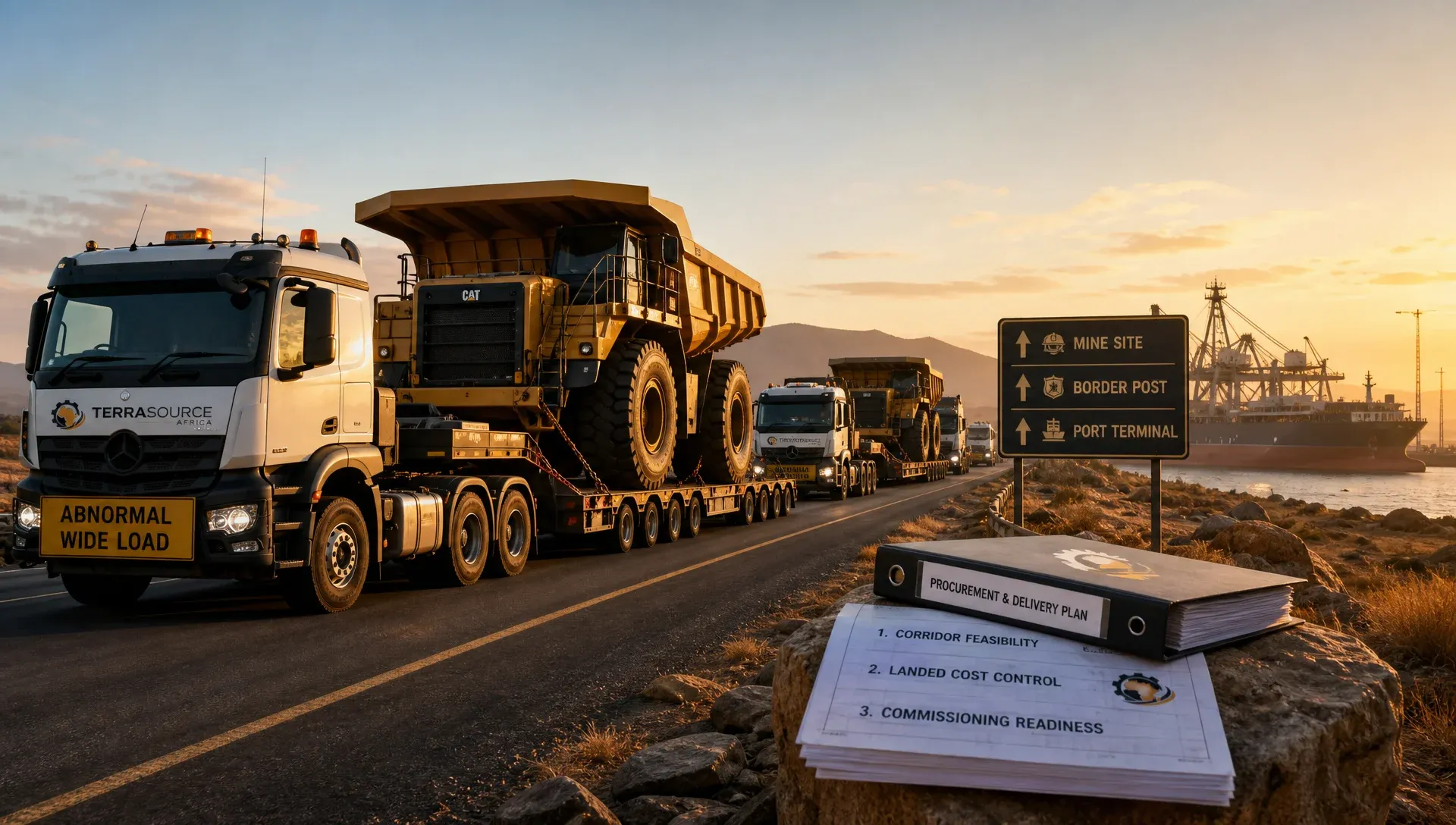
Integrated delivery control planning: Develop dated route execution plans covering port selection, laydown requirements, dismantling scope, packing specifications, abnormal-load engineering, permit lead times per jurisdiction, and border sequencing.
Proactive compliance management: Handle correct HS codes, duty optimization, VAT strategy, transit bonds, and appointment systems during planning phases. Link financial milestones to delivery achievements, not promises.
Alternative routing with triggers: Establish pre-approved secondary routes via alternate ports or crossings, activated by defined events such as dwell time exceeding 72 hours.
Operational readiness support: Stage commissioning spares and critical wear parts within corridor reach to maintain production after equipment handover.
Real-time route visibility: Implement GPS tracking and document-status reporting tied to payment releases and site preparation, providing buyer-side clarity throughout transit.
This represents procurement discipline applied across the complete supply chain—commercially controlled sourcing with integrated delivery control.
Corridor-Specific Risk Profiles: Where Theory Meets Reality
Different African mining corridors present distinct commercial challenges. Here’s how disciplined procurement responds to major route realities:
Central African Copperbelt Operations
Route dynamics: Equipment typically moves via Durban/Richards Bay, Walvis Bay, Dar es Salaam, or Beira ports, with emerging Lobito rail capacity. Critical border points include Kazungula Bridge, Chirundu, Tunduma/Nakonde, and Kasumbalesa.
Common failure points: Outdated port congestion assumptions, underestimating Kasumbalesa processing variability, and ignoring seasonal axle restrictions plus escort scheduling constraints.
Controlled response: Dual-port pricing with primary and contingent options, dismantling engineered for the most restrictive corridor segment, and pre-secured escort allocations. Customs documentation built around mining capital equipment codes with transit bonds synchronized to actual border timing. Major expansions like the Kansanshi S3 project demonstrate how schedule reliability directly impacts billion-dollar investment returns.
West African Gold Corridors
Route dynamics: Primary ports include Tema/Takoradi, Abidjan, Dakar, and Lomé serving inland operations. Routes to major mines face rainy-season degradation, security-driven convoy requirements, and variable axle enforcement.
Common failure points: Port selection based purely on freight rates without factoring convoy requirements or seasonal restrictions, plus oversize shipments without corridor-appropriate dismantling.
Controlled response: Security-conditional routing integrated into lead times and pricing, convoy slots secured before vessel booking, customs pre-clearance for mining equipment exemptions, and commissioning spares positioned at border points.
Southern African Platinum and Coal Routes
Route dynamics: High regulatory oversight for abnormal loads, complex multi-province permitting, and frequent weekend/holiday movement restrictions. Cross-border legs via Beitbridge or Kazungula demand precise documentation.
Common failure points: Late abnormal-load permits and over-height shipments requiring emergency dismantling, plus misaligned handover timing with mine crane availability.
Controlled response: Province-by-province permit calendars, dismantling drawings approved before packing, and handover windows locked to site lifting schedules. As operations like Tharisa advance connected mining systems, equipment availability becomes increasingly schedule-critical.
East African Access Routes
Route dynamics: Mombasa–Malaba/Busia and Dar es Salaam–Tunduma corridors serving Uganda and DRC operations face weighbridge congestion and seasonal road stress.
Common failure points: Underestimating regional oversize restrictions and escort requirements, treating East African routes as less complex than they actually are.
Controlled response: Early weighbridge coordination, dismantling to regional height limits, and customs documentation designed for through-bills and bonded warehousing where beneficial.
Commercial Takeaway: Control the Corridor, Control the Cost
Delay costs on project-critical mobile equipment are punitive and compound rapidly. You control them by controlling the corridor through disciplined procurement that prioritizes route strength over headline pricing.
Move beyond country risk ratings to corridor-specific procurement planning. Add Corridor Risk Factors to every RFQ: port reliability, border clearance consistency, permit cycle times, escort availability, seasonal restrictions, currency exposure, supplier route credibility, and operational support planning.
TerraSource Africa delivers commercially controlled sourcing with integrated delivery control across African mining corridors. Schedule a corridor-specific project consultation to validate your route strategy, supplier credibility, and delivery plan before committing capital to your next equipment procurement.
TerraSource Africa is a commercially disciplined sourcing and delivery partner for project-critical mobile equipment across African project corridors.
Read next
Related posts

Africa's Critical Minerals Boom: Is Your Equipment Strategy Risking It All?
Africa's critical minerals boom is forcing rushed equipment decisions. Learn why a corridor-first procurement strategy is essential to protect project timelines, control landed costs, and avoid catastrophic delays.
Beitbridge, Kasumbalesa & Beyond: Navigating Africa's Most Challenging Equipment Corridors
Discover which routes across Africa are the most challenging for moving earthmoving equipment. This guide analyzes the risks of Beitbridge, Kasumbalesa, and other key corridors, showing buyers how to control landed costs and avoid project delays.
Beyond Unit Price: 3 Procurement Levers Mine Operators Must Control in Africa
Stop letting procurement's unit-price focus derail your mining schedule. Discover the three operational levers mine operators must control to manage corridor risk, guarantee delivery, and own total landed cost in Africa.